
If the foot of the perpendicular drawn from to the line passing through the point and parallel to the planes and is , then is equal to:
- A
- B
- C
- D
If the foot of the perpendicular drawn from to the line passing through the point and parallel to the planes and is , then is equal to:
Correct answer:D
Standard Method
Given: The line passes through and is parallel to the intersection of the planes and . The point is .
Find: where is the foot of the perpendicular from to the line.
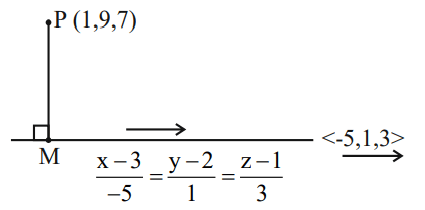
Direction ratio of line
So a direction vector is .
A general point on the line is
Since is perpendicular to the line direction ,
Hence,
Therefore,
So,
Therefore, the correct option is D.
Parametric Solution
Given: The line passes through and is parallel to the intersection of the planes and .
Find: The value of .
From , we get
Substitute in :
Thus the direction ratios are .
Parametric form of the line:
So the foot of the perpendicular is .
Vector from to this point is
This is perpendicular to . Hence,
Now,
Therefore,
So the correct option is D.
Using the normals of the two planes directly as the line direction. This is wrong because the required line is parallel to the intersection of the planes, so its direction vector is the cross product of the plane normals. Use .
Writing the perpendicular condition incorrectly. The vector from the given point to the foot must be perpendicular to the line direction, so its dot product with must be zero. Do not equate coordinates directly.
Making sign errors while forming . If and , then . A wrong sign changes the value of .
Get unlimited AI-adaptive practice, mastery tracking, and an AI tutor that explains every step — free to start.