MCQMediumJEE 2023Circular Motion Dynamics

JEE Physics 2023 Question with Solution

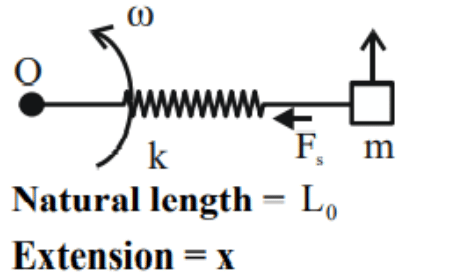
A body of mass 200g200 \, \text{g} is tied to a spring of spring constant 12.5N/m12.5 \, \text{N/m}, while the other end of the spring is fixed at point OO. If the body moves about OO in a circular path on a smooth horizontal surface with constant angular speed 5rad/s5 \, \text{rad/s}, then the ratio of extension in the spring to its natural length will be:

  • A

    1:21:2

  • B

    1:11:1

  • C

    2:32:3

  • D

    2:52:5

Answer

Correct answer:B

Step-by-step solution

Standard Method

Given: Mass of the body is m=200g=0.2kgm = 200 \, \text{g} = 0.2 \, \text{kg}, spring constant is k=12.5N/mk = 12.5 \, \text{N/m}, and angular speed is ω=5rad/s\omega = 5 \, \text{rad/s}.

Find: The ratio of extension xx in the spring to its natural length L0L_0.

Let the natural length of the spring be L0L_0 and the extension be xx. Then the radius of circular motion is L0+xL_0 + x. The spring force provides the required centripetal force, so

kx=m(L0+x)ω2kx = m(L_0 + x)\omega^2

Substituting the given values,

12.5x=0.2(L0+x)(52)12.5x = 0.2(L_0 + x)(5^2) 12.5x=0.2(L0+x)(25)12.5x = 0.2(L_0 + x)(25) 12.5x=5(L0+x)12.5x = 5(L_0 + x)

Now simplify,

12.5x=5L0+5x12.5x = 5L_0 + 5x 7.5x=5L07.5x = 5L_0 xL0=57.5=23\frac{x}{L_0} = \frac{5}{7.5} = \frac{2}{3}

Therefore, the ratio of extension to natural length is 2:32:3.

The solution working gives x/L0=2/3x/L_0 = 2/3, which corresponds to option C. The solution incorrectly labels the correct option as B.

Using the circular motion radius explicitly

Given: The body moves in a circle on a smooth horizontal surface, so no other horizontal force contributes to the centripetal force except the spring force.

The circular radius is not the natural length alone. It is the stretched length of the spring, that is L0+xL_0 + x.

A spring fixed at point O with a mass m at the other end rotating about O, showing angular speed omega, spring constant k, restoring force Fs, natural length L0, and extension x.

Hence the centripetal-force equation is

spring force=centripetal force\text{spring force} = \text{centripetal force} kx=m(L0+x)ω2kx = m(L_0 + x)\omega^2

Using m=0.2m = 0.2 and ω=5\omega = 5,

kx=0.2(L0+x)25=5(L0+x)kx = 0.2(L_0 + x)25 = 5(L_0 + x)

Since k=12.5k = 12.5,

12.5x=5(L0+x)12.5x = 5(L_0 + x) 12.5x=5L0+5x12.5x = 5L_0 + 5x 7.5x=5L07.5x = 5L_0 xL0=57.5=23\frac{x}{L_0} = \frac{5}{7.5} = \frac{2}{3}

So the correct option should be C.

Common mistakes

  • Using the natural length L0L_0 as the radius of circular motion is incorrect because the body rotates at the stretched length L0+xL_0 + x. Always use the actual distance from OO to the body as the radius.

  • Equating kxkx directly to mL0ω2mL_0\omega^2 ignores the extension in the radius term. The spring force depends on extension, but the centripetal force depends on the full radius.

  • Missing the unit conversion 200g=0.2kg200 \, \text{g} = 0.2 \, \text{kg} leads to an incorrect numerical result. Convert mass to SI units before substitution.

Practice more Circular Motion Dynamics questions

Get unlimited AI-adaptive practice, mastery tracking, and an AI tutor that explains every step — free to start.

Related questions