MCQMediumJEE 2026Aldehydes & Ketones

JEE Chemistry 2026 Question with Solution

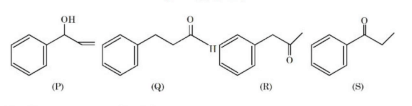
Given below are the four isomeric compounds P,Q,R,SP, Q, R, S:

Four aromatic isomeric compounds labeled P, Q, R and S are shown with benzene ring attached to different oxygen-containing side chains.

PP: Aromatic compound containing an OH-\mathrm{OH} group QQ: Aromatic compound containing an CHO-\mathrm{CHO} group (aldehyde) RR: Aromatic compound containing a ketone group SS: Aromatic compound containing a ketone group

Identify the correct statements from below:

[A.] Q,RQ, R and SS will give precipitate with 2,42,4-DNP. [B.] PP and QQ will give positive Baeyer’s test. [C.] QQ and RR will give sooty flame. [D.] RR and SS will give yellow precipitate with I2/NaOHI_2/\mathrm{NaOH}. [E.] QQ alone will deposit silver with Tollens’ reagent.

Choose the correct option.

  • A

    A, B, D and E only

  • B

    C and E only

  • C

    A and E only

  • D

    A, C and E only

Answer

Correct answer:D

Step-by-step solution

Standard Method

Given: Four aromatic isomeric compounds P,Q,R,SP, Q, R, S are provided. PP contains OH-\mathrm{OH}, QQ contains CHO-\mathrm{CHO}, and R,SR, S are ketones.

Find: Which among statements A to E are correct.

Step 1: Test with 2,42,4-DNP

2,42,4-DNP gives a precipitate with aldehydes and ketones.

  • QQ: aldehyde ✓
  • RR: ketone ✓
  • SS: ketone ✓
  • PP: alcohol ✗
Statement A is true.\Rightarrow \text{Statement A is true.}

Step 2: Baeyer’s test

Baeyer’s test is given by compounds containing C=C\mathrm{C=C} or CC\mathrm{C\equiv C}.

  • PP: phenolic compound, no alkene ✗
  • QQ: aldehyde, no alkene ✗
Statement B is false.\Rightarrow \text{Statement B is false.}

Step 3: Sooty flame test

Aromatic compounds generally burn with a sooty flame due to high carbon content.

Q and R are aromatic  sooty flameQ \text{ and } R \text{ are aromatic } \Rightarrow \text{ sooty flame}Statement C is true.\Rightarrow \text{Statement C is true.}

Step 4: Iodoform test

Iodoform test is given by methyl ketones (COCH3)(-\mathrm{COCH_3}) and ethanol.

Only compound SS is a methyl ketone, not RR.

Statement D is false.\Rightarrow \text{Statement D is false.}

Step 5: Tollens’ test

Tollens’ reagent gives a silver mirror with aldehydes.

Q is an aldehyde  positiveQ \text{ is an aldehyde } \Rightarrow \text{ positive}

Others are ketones or alcohols.

Statement E is true.\Rightarrow \text{Statement E is true.}

Therefore, the correct statements are A, C and E only. The correct option is D.

Test-wise Elimination

Given: The compounds differ by functional group placement on an aromatic framework.

Find: Which statements survive functional group tests.

Use each named test separately:

  1. 2,42,4-DNP test identifies carbonyl compounds of aldehyde and ketone type. So Q,R,SQ, R, S respond, while PP does not.
  2. Baeyer’s test is for unsaturation such as C=C\mathrm{C=C} or CC\mathrm{C\equiv C}, not for a phenolic OH-\mathrm{OH} or an aldehyde group alone here. So statement B is rejected.
  3. Sooty flame is expected for aromatic compounds, so the listed aromatic compounds QQ and RR satisfy statement C.
  4. Iodoform test requires a methyl ketone. The solution identifies only SS as methyl ketone, so the pair RR and SS is incorrect. Hence D is false.
  5. Tollens’ reagent is positive for aldehydes, so only QQ gives silver deposition.

Thus only statements A, C, E are correct, so the correct option is D.

Common mistakes

  • Assuming every compound with oxygen gives a positive 2,42,4-DNP test is incorrect because 2,42,4-DNP reacts with aldehydes and ketones, not alcohols or phenols. Check the functional group first.

  • Confusing Baeyer’s test with a general oxidation test is wrong because it is primarily used for unsaturation such as C=C\mathrm{C=C} or CC\mathrm{C\equiv C}. Do not mark a compound positive only because it contains oxygen.

  • Treating every ketone as iodoform-positive is incorrect because the iodoform test requires a methyl ketone (COCH3)(-\mathrm{COCH_3}). Identify whether the carbonyl carbon is attached to a CH3\mathrm{CH_3} group.

  • Assuming all carbonyl compounds respond to Tollens’ reagent is wrong because Tollens’ test is characteristic of aldehydes, while ordinary ketones do not give the silver mirror. Separate aldehydes from ketones carefully.

Practice more Aldehydes & Ketones questions

Get unlimited AI-adaptive practice, mastery tracking, and an AI tutor that explains every step — free to start.

Related questions