
Match the LIST-I with LIST-II
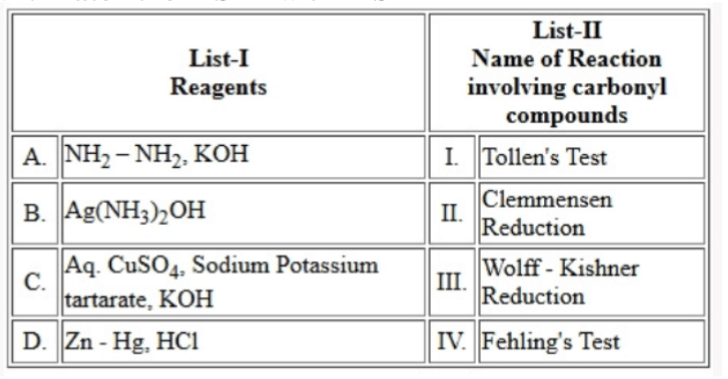
Choose the correct answer from the options given below:
- A
A–IV, B–III, C–II, D–I
- B
A–II, B–I, C–IV, D–III
- C
A–III, B–IV, C–I, D–II
- D
A–III, B–I, C–IV, D–II
Match the LIST-I with LIST-II
Choose the correct answer from the options given below:
A–IV, B–III, C–II, D–I
A–II, B–I, C–IV, D–III
A–III, B–IV, C–I, D–II
A–III, B–I, C–IV, D–II
Correct answer:D
Standard Method
Given: A matching question between reagents in List-I and names of reactions involving carbonyl compounds in List-II.
Find: The correct correspondence between A, B, C, D and I, II, III, IV.
Step 1: Identify each reagent and reaction.
Step 2: Match correctly.
Therefore, the correct option is D.
Reaction Identification
Given: The reagents are listed and each must be matched with a named carbonyl reaction.
Find: Which option gives the correct matching.
The key identifications are:
Thus the final matching is:
Hence, the correct option is D.
Confusing Wolff–Kishner reduction with Clemmensen reduction. This is wrong because Wolff–Kishner uses basic medium with , whereas Clemmensen uses acidic medium with . Match them by reagent and reaction medium.
Mistaking for Fehling's reagent. This is wrong because is Tollen's reagent. Fehling's test uses aqueous with sodium potassium tartrate and .
Ignoring the complete composition of Fehling's reagent. This is wrong because the copper salt alone is not sufficient for identification; the presence of sodium potassium tartrate and alkaline medium confirms Fehling's test. Read the full reagent set before matching.
Get unlimited AI-adaptive practice, mastery tracking, and an AI tutor that explains every step — free to start.