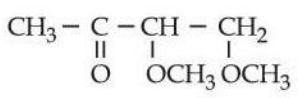
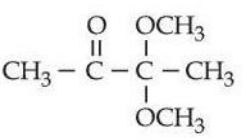
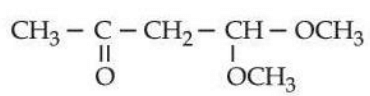
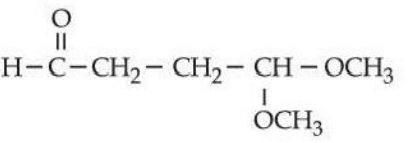
An organic compound "P" of molecular formula C7H12O (likely C7H12O2 or similar based on options), gives positive Iodoform test but negative Tollen's test. When "P" is treated with dilute acid, it produces "Q". "Q" gives positive Tollen's test and also Iodoform test. The structure of "P" is:
A
B
C
D
Answer
Correct answer:B
Step-by-step solution
Standard Method
Given:P gives positive Iodoform test and negative Tollen's test. On treatment with dilute acid, P gives Q. Compound Q gives both positive Tollen's test and positive Iodoform test.
Find: The correct structure of P.
A positive Iodoform test means the compound must contain either a methyl ketone group or a group that can produce it.
A negative Tollen's test means P is not an aldehyde.
After hydrolysis with dilute acid, Q gives positive Tollen's test as well as Iodoform test. Therefore Q must contain both an aldehyde group and a methyl ketone group.
From the solution, Q is identified as:
CH3−CO−CH2−CHO
This is a compound having both the required functionalities.
So P must be a protected form of this aldehyde, where the aldehyde is converted into an acetal, because acetals hydrolyse in dilute acid to regenerate aldehydes while remaining negative to Tollen's reagent.
Q gives both Tollen's and Iodoform tests positive.
Find: Which option represents P.
Step 1: Use the tests.
Iodoform positive implies presence of a methyl ketone unit.
Tollen's negative implies absence of a free aldehyde group in P.
Step 2: Analyze Q.
Tollen's positive means Q contains an aldehyde.
Iodoform positive means Q also contains a methyl ketone.
So Q must be a molecule containing both groups together.
Step 3: Infer the transformation.
Dilute acid commonly hydrolyses acetals to aldehydes. Therefore P should be an acetal-protected aldehyde that still retains the ketone functionality.
That gives the structure:
CH3−C(=O)−CH2−CH(OCH3)2
which upon acid hydrolysis forms:
CH3−CO−CH2−CHO
Hence the option corresponding to the aldehyde-protected ketone is the correct choice.
The solution explicitly states that the correct option is B.
Common mistakes
Assuming a positive Iodoform test means the compound must be an aldehyde. This is wrong because the Iodoform test mainly indicates a methyl ketone or related methyl carbinol system. First identify that Tollen's negative rules out a free aldehyde in P.
Ignoring the effect of dilute acid and checking only the functional groups present initially. This is wrong because dilute acid can hydrolyse an acetal and reveal an aldehyde in Q. The reaction step must be used to infer the hidden functionality.
Choosing a structure with a free aldehyde in P. This is wrong because such a compound would give a positive Tollen's test immediately. The correct structure must mask the aldehyde before hydrolysis.
Practice more Aldehydes & Ketones questions
Get unlimited AI-adaptive practice, mastery tracking, and an AI tutor that explains every step — free to start.