
The equivalent resistance between the points and in the given circuit is Find the value of .
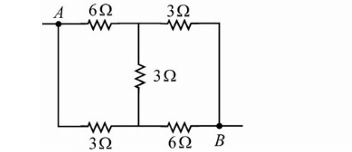
The equivalent resistance between the points and in the given circuit is Find the value of .
Correct answer:22.5
Standard Method
Given: The equivalent resistance between points and is .
Find: The value of .
Concept: Use symmetry in the resistor network. In a symmetric bridge, the resistor joining two equipotential points carries no current.
From the solution, the circuit is symmetric about the vertical line through the middle. Hence, the potentials at the midpoints of the top and bottom branches are equal, so no current flows through the central resistor.
After removing that branch, the network reduces to two parallel branches between and :
Now the equivalent resistance is
Given that
So,
Therefore, the value of is .
Symmetry Shortcut
Given: A symmetric resistor network is connected between and .
Find: The value of if the equivalent resistance is .
Because the circuit is symmetric, the two central junctions are at the same potential. Therefore, the bridge resistor of has zero current and can be ignored.
That leaves two equal branches of each in parallel, so identical resistors in parallel give half their value:
Now compare with the given form:
Therefore, the correct numerical value is .
Assuming current flows through the central resistor. In a symmetric network, the two ends of that resistor are at the same potential, so the potential difference across it is zero. Check equipotential points before applying series-parallel reduction.
Combining all visible resistors directly in series or parallel. The original network is a bridge circuit, so ordinary series-parallel reduction is not valid until symmetry is used to remove the zero-current branch.
Finding the equivalent resistance correctly as but forgetting the question asks for in . After computing resistance, always compare it with the given expression and solve for the required variable.
Get unlimited AI-adaptive practice, mastery tracking, and an AI tutor that explains every step — free to start.