MCQEasyJEE 2025Combination of Resistors

JEE Physics 2025 Question with Solution

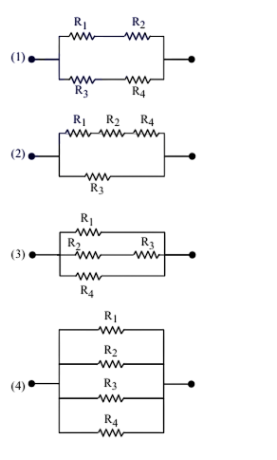
From the combination of resistors with resistance values R1=R2=R3=5ΩR_1 = R_2 = R_3 = 5 \, \Omega and R4=10ΩR_4 = 10 \, \Omega, which of the following combination is the best circuit to get an equivalent resistance of 6Ω6 \, \Omega?

Four resistor network options labeled 1 to 4, showing different series and parallel combinations of R1, R2, R3, and R4 between two terminals.
  • A

    Option 11

  • B

    Option 22

  • C

    Option 33

  • D

    Option 44

Answer

Correct answer:A

Step-by-step solution

Standard Method

Given: R1=R2=R3=5ΩR_1 = R_2 = R_3 = 5 \, \Omega and R4=10ΩR_4 = 10 \, \Omega.

Find: Which circuit gives equivalent resistance 6Ω6 \, \Omega.

From the solution, the correct selection is stated to be Option A. The required principle is combination of resistors in series and parallel.

For the first option, the top branch has R1R_1 and R2R_2 in series, and the bottom branch has R3R_3 and R4R_4 in series. Therefore,

Rtop=R1+R2=5+5=10ΩR_{\text{top}} = R_1 + R_2 = 5 + 5 = 10 \, \Omega

and

Rbottom=R3+R4=5+10=15ΩR_{\text{bottom}} = R_3 + R_4 = 5 + 10 = 15 \, \Omega

These two branches are in parallel, so

Req=RtopRbottomRtop+RbottomR_{\text{eq}} = \frac{R_{\text{top}} R_{\text{bottom}}}{R_{\text{top}} + R_{\text{bottom}}} Req=10×1510+15=15025=6ΩR_{\text{eq}} = \frac{10 \times 15}{10 + 15} = \frac{150}{25} = 6 \, \Omega

Therefore, the circuit in Option A gives the required equivalent resistance of 6Ω6 \, \Omega. The correct option is A.

Check using series-parallel formulas

Given: R1=R2=R3=5ΩR_1 = R_2 = R_3 = 5 \, \Omega and R4=10ΩR_4 = 10 \, \Omega.

Find: The option whose equivalent resistance is 6Ω6 \, \Omega.

Use the standard formulas:

Rseries=R1+R2+R_{\text{series}} = R_1 + R_2 + \dots 1Rparallel=1R1+1R2+\frac{1}{R_{\text{parallel}}} = \frac{1}{R_1} + \frac{1}{R_2} + \dots

The solution explicitly states that the first option gives the desired equivalent resistance of 6Ω6 \, \Omega and concludes, "Thus, the correct answer is (1)." This maps to A.

Common mistakes

  • Treating the first circuit as if all four resistors are in one series chain is wrong because the diagram has two separate branches between the same terminals. First identify branch structure, then combine the branches in parallel.

  • Adding parallel resistances directly is wrong. For parallel branches, use either

    1Req=1R1+1R2\frac{1}{R_{\text{eq}}} = \frac{1}{R_1} + \frac{1}{R_2}

    or the two-branch product formula

    R_{\text{eq}} = \frac{R_1R_2}{R_1+R_2} $$.
  • Using the resistor values incorrectly by taking all of R1,R2,R3R_1, R_2, R_3 as parallel and then adding R4R_4 in series is wrong for this question because that is not the arrangement of the correct option. Always read the actual circuit diagram before calculating.

Practice more Combination of Resistors questions

Get unlimited AI-adaptive practice, mastery tracking, and an AI tutor that explains every step — free to start.

Related questions