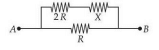
Two known resistances of and and one unknown resistance are connected in a circuit as shown in the figure. If the equivalent resistance between points and in the circuit is , then the value of is _____ .
- A
- B
- C
- D
Two known resistances of and and one unknown resistance are connected in a circuit as shown in the figure. If the equivalent resistance between points and in the circuit is , then the value of is _____ .

Correct answer:B
Standard Method
Given: Two known resistances are and , and the unknown resistance is . The equivalent resistance between and is given to be .
Find: The value of .
From the circuit, the resistor is in parallel with the series combination . Therefore,
Since ,
Cross-multiplying,
Using the quadratic formula,
Since resistance cannot be negative, we take the positive root.
Therefore, the value of is , so the correct option is B.
Quadratic Setup from Equivalent Resistance
Given: The equivalent resistance of the network is itself equal to the unknown resistance .
Find: The value of by forming and solving the circuit equation.
The key idea is to first write the equivalent resistance of the visible series-parallel combination. The upper branch contains and in series, so that branch has resistance
This branch is in parallel with the lower branch of resistance . Hence,
Now use the given condition :
Multiply both sides by :
Expand both sides:
Bring all terms to one side:
This is a quadratic in . Solving,
The physically acceptable value is the positive one:
Therefore, the correct option is B.
Treating all three resistors as if they are in simple series is incorrect because the branch containing is in parallel with the branch containing and . First identify the network structure, then apply the parallel-resistance formula.
Writing the parallel combination denominator as instead of is wrong. In a parallel combination, the sum of the two branch resistances appears in the denominator.
Keeping the negative root of the quadratic is physically invalid here. Resistance must be positive, so after solving the quadratic, reject the negative value and keep the positive root only.
Get unlimited AI-adaptive practice, mastery tracking, and an AI tutor that explains every step — free to start.