MCQEasyJEE 2026Isomerism (Structural, Stereoisomerism)

JEE Chemistry 2026 Question with Solution

Given below are two statements regarding conformations of n-butane. Choose the correct option.

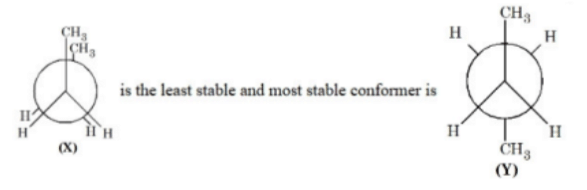
Required conformation diagram for n-butane statements is missing from the source, so the two labeled statements are not visible.
  • A

    Both Statement I and Statement II are false

  • B

    Statement I is false but Statement II is true

  • C

    Statement I is true but Statement II is false

  • D

    Both Statement I and Statement II are true

Answer

Correct answer:D

Step-by-step solution

Standard Method

Given: Two statements regarding conformations of n-butane are to be checked.

Find: Which option correctly identifies the truth values of Statement I and Statement II.

From the extracted solution:

  1. Stability of conformers: In n-butane, the eclipsed conformation is the least stable due to maximum torsional strain, while the anti-staggered conformation is the most stable.
  2. Effect of dihedral angle: As the dihedral angle increases from eclipsed to staggered, torsional strain decreases, so stability increases.
  3. Therefore, both statements are correct according to the solution.

The correct option is D.

Note: The actual two statements are not visible in the given question because the required image/content is missing, but the solution explicitly concludes that both statements are true.

Common mistakes

  • Assuming that every staggered conformation of n-butane has the same stability is incorrect. The anti-staggered form is more stable than the gauche form because steric repulsion is minimum in the anti arrangement.

  • Confusing torsional strain with general steric crowding can lead to wrong conclusions. For conformational comparison, first check whether the conformation is eclipsed or staggered, then compare relative repulsions.

Practice more Isomerism (Structural, Stereoisomerism) questions

Get unlimited AI-adaptive practice, mastery tracking, and an AI tutor that explains every step — free to start.

Related questions