
Match List - I with List - II.
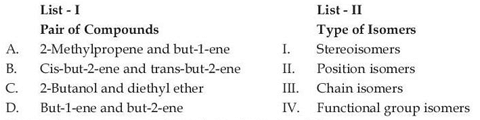
Choose the correct answer from the options given below :
- A
A-II, B-I, C-IV, D-III
- B
A-I, B-IV, C-III, D-II
- C
A-III, B-I, C-II, D-IV
- D
A-III, B-I, C-IV, D-II
Match List - I with List - II.
Choose the correct answer from the options given below :
A-II, B-I, C-IV, D-III
A-I, B-IV, C-III, D-II
A-III, B-I, C-II, D-IV
A-III, B-I, C-IV, D-II
Correct answer:D
Standard Method
Given: List I contains pairs of organic compounds and List II contains types of isomerism.
Find: The correct matching between the compound pairs and the isomer types.
Step 1: Understanding the concept Isomers are molecules with the same molecular formula but different arrangements of atoms. Structural isomers include chain, position, and functional isomers. Stereoisomers include geometric and optical isomers.
Step 2: Match each pair
For A. 2-Methylpropene and but-1-ene:
Both have the same molecular formula. 2-Methylpropene has a branched carbon skeleton, whereas but-1-ene has a straight chain. Therefore, these are chain isomers (III).
For B. cis-but-2-ene and trans-but-2-ene: These differ in spatial arrangement around the double bond. Therefore, these are geometric isomers, which are a type of stereoisomers (I).
For C. 2-Butanol and diethyl ether:
One is an alcohol and the other is an ether. Therefore, these are functional group isomers (IV).
For D. But-1-ene and but-2-ene: These differ only in the position of the double bond, at versus . Therefore, these are position isomers (II).
Conclusion: The correct matching is A-III, B-I, C-IV, D-II. Therefore, the correct option is D.
Stepwise Classification
Given: Four compound pairs are to be matched with four isomer categories.
Find: Which option gives the correct one-to-one correspondence.
Applying these definitions:
Hence the final matching is A-III, B-I, C-IV, D-II, so the correct option is D.
Confusing chain isomerism with position isomerism for 2-methylpropene and but-1-ene. This is wrong because the carbon skeleton changes, not merely the position of a double bond. Check whether branching changes before calling it position isomerism.
Treating cis-but-2-ene and trans-but-2-ene as structural isomers. This is wrong because their connectivity is the same; only spatial arrangement differs. Such pairs are stereoisomers, specifically geometric isomers.
Missing functional group isomerism in 2-butanol and diethyl ether. This is wrong because alcohol and ether have different functional groups despite the same molecular formula. Identify the functional group first before matching.
Get unlimited AI-adaptive practice, mastery tracking, and an AI tutor that explains every step — free to start.