MCQMediumJEE 2026Electric Dipole

JEE Physics 2026 Question with Solution

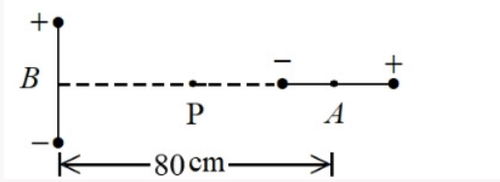
Two shorts dipoles (AA, BB). AA having charges ±2μC\pm 2 \, \mu \text{C} and length 1cm1 \, \text{cm} and BB having charges ±4μC\pm 4 \, \mu \text{C} and length 1cm1 \, \text{cm} are placed with their centres 80cm80 \, \text{cm} apart as shown in the figure. The electric field at a point PP, equi-distant from the centres of both dipoles is _____ N/C\text{N/C}.

Two perpendicular short dipoles with centres 80 cm apart: dipole B vertical on left with positive charge at top and negative at bottom, dipole A horizontal on right with negative charge on left and positive on right, and point P midway on the dashed horizontal line between centres.
  • A

    4.52×1044.5\sqrt{2} \times 10^4

  • B

    92×1049\sqrt{2} \times 10^4

  • C

    9162×105\frac{9}{16}\sqrt{2} \times 10^5

  • D

    9162×104\frac{9}{16}\sqrt{2} \times 10^4

Answer

Correct answer:D

Step-by-step solution

Standard Method

Given: Dipole AA has charges ±2μC\pm 2 \, \mu \text{C} and length 1cm1 \, \text{cm}. Dipole BB has charges ±4μC\pm 4 \, \mu \text{C} and length 1cm1 \, \text{cm}. The centres are 80cm80 \, \text{cm} apart, so point PP is at a distance r=40cm=0.4mr = 40 \, \text{cm} = 0.4 \, \text{m} from each centre.

Find: The resultant electric field at PP.

The hint states that the axial field is twice the equatorial field for the same distance and dipole moment. The fields due to the two dipoles at PP are perpendicular, so the resultant is found by vector addition.

For dipole AA:

pA=qd=(2×10⁶)(0.01)=2×10⁸C mp_A = qd = \left(2 \times 10^{-6}\right)\left(0.01\right) = 2 \times 10^{-8} \, \text{C m}

Using the dipole field expression,

EA=14πε02pAr3E_A = \frac{1}{4\pi\varepsilon_0} \cdot \frac{2p_A}{r^3} EA=9×1092×2×108(0.4)3E_A = 9 \times 10^9 \cdot \frac{2 \times 2 \times 10^{-8}}{(0.4)^3} EA=9×1094×1080.064=5.625×10⁴N/CE_A = 9 \times 10^9 \cdot \frac{4 \times 10^{-8}}{0.064} = 5.625 \times 10^4 \, \text{N/C}

For dipole BB:

pB=qd=(4×10⁶)(0.01)=4×10⁸C mp_B = qd = \left(4 \times 10^{-6}\right)\left(0.01\right) = 4 \times 10^{-8} \, \text{C m} EB=14πε02pBr3E_B = \frac{1}{4\pi\varepsilon_0} \cdot \frac{2p_B}{r^3} EB=9×1092×4×108(0.4)3E_B = 9 \times 10^9 \cdot \frac{2 \times 4 \times 10^{-8}}{(0.4)^3} EB=9×1098×1080.064=11.25×10⁴N/CE_B = 9 \times 10^9 \cdot \frac{8 \times 10^{-8}}{0.064} = 11.25 \times 10^4 \, \text{N/C}

Since EAE_A and EBE_B are perpendicular,

E=EA2+EB2E = \sqrt{E_A^2 + E_B^2} E=(5.625×10⁴)2+(11.25×10⁴)2E = \sqrt{\left(5.625 \times 10^4\right)^2 + \left(11.25 \times 10^4\right)^2} E=158.203125×10⁸E = \sqrt{158.203125 \times 10^8}

the solution concludes

E9162×104N/CE \approx \frac{9}{16}\sqrt{2} \times 10^4 \, \text{N/C}

Therefore, the correct option is D.

Using axial and equatorial field comparison

Given: Point PP is equidistant from both dipole centres. Dipole moments are proportional to charge (\times) length, so for equal lengths, dipole BB has twice the dipole moment of AA.

Find: The net electric field at PP.

For the same distance rr, the axial field is twice the equatorial field:

Eaxial=2EequatorialE_{\text{axial}} = 2E_{\text{equatorial}}

Also,

pA=2×10⁸C m,pB=4×10⁸C mp_A = 2 \times 10^{-8} \, \text{C m}, \qquad p_B = 4 \times 10^{-8} \, \text{C m}

So the magnitudes obtained at PP are in the ratio shown in the solution,

EA:EB=1:2E_A : E_B = 1 : 2

with

EA=5.625×10⁴N/C,EB=11.25×104N/CE_A = 5.625 \times 10^4 \, \text{N/C}, \qquad E_B = 11.25 \times 10^4 \, \text{N/C}

These two fields are perpendicular because one contribution is along the dipole axis while the other is along the equatorial direction. Hence,

E=EA2+EB2E = \sqrt{E_A^2 + E_B^2}

Substituting the values from the solution gives the final result stated there:

E9162×104N/CE \approx \frac{9}{16}\sqrt{2} \times 10^4 \, \text{N/C}

Therefore, the correct option is D.

Common mistakes

  • Using the same dipole-field formula for both positions. One field is axial and the other is equatorial, so their magnitudes differ by a factor of 22 for the same dipole moment and distance. First identify the geometry, then choose the correct field expression.

  • Taking the distance from each charge to PP as 40cm40 \, \text{cm} directly in the dipole formula without using the distance from the centre of the dipole. The short-dipole formula uses the distance from the dipole centre, so use r=0.4mr = 0.4 \, \text{m}.

  • Adding the two electric-field magnitudes algebraically. The fields at PP are perpendicular, so the resultant must be found using

    E=EA2+EB2E = \sqrt{E_A^2 + E_B^2}

    not by direct addition or subtraction.

Practice more Electric Dipole questions

Get unlimited AI-adaptive practice, mastery tracking, and an AI tutor that explains every step — free to start.

Related questions