MCQMediumJEE 2025Electric Dipole

JEE Physics 2025 Question with Solution

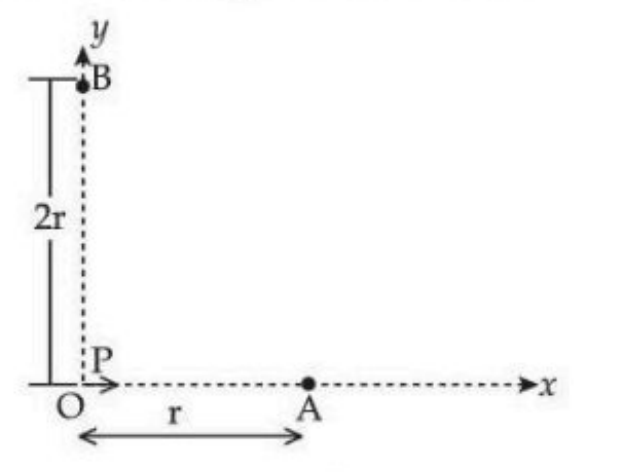
For a short dipole placed at origin OO, the dipole moment PP is along the xx-axis, as shown in the figure. If the electric potential and electric field at AA are V0V_0 and E0E_0 respectively, then the correct combination of the electric potential and electric field, respectively, at point BB on the yy-axis is given by:

A short dipole at origin O with dipole moment P along positive x-axis, point A on x-axis at distance r, and point B on y-axis at distance 2r above O.
  • A

    V04,E04\frac{V_0}{4}, \frac{E_0}{4}

  • B

    0,E0160, \frac{E_0}{16}

  • C

    V02,E016\frac{V_0}{2}, \frac{E_0}{16}

  • D

    E08\frac{E_0}{8}

Answer

Correct answer:B

Step-by-step solution

Standard Method

Given: A short dipole is placed at origin OO with dipole moment PP along the xx-axis. At point AA, the electric potential and electric field are V0V_0 and E0E_0 respectively. Point BB lies on the yy-axis.

Find: The electric potential and electric field at point BB.

For a short dipole, the potential at a point is

V=14πε0pcosθr2V = \frac{1}{4\pi\varepsilon_0}\frac{p\cos\theta}{r^2}

Since point BB is on the perpendicular bisector of the dipole, θ=90\theta = 90^\circ and hence cosθ=0\cos\theta = 0. Therefore,

VB=0V_B = 0

For the electric field on the equatorial line of a short dipole,

E=14πε0pr3E = \frac{1}{4\pi\varepsilon_0}\frac{p}{r^3}

At point AA on the axial line,

E0=14πε02pr3E_0 = \frac{1}{4\pi\varepsilon_0}\frac{2p}{r^3}

Point BB is at distance 2r2r from the dipole, so the equatorial field there is

EB=14πε0p(2r)3E_B = \frac{1}{4\pi\varepsilon_0}\frac{p}{(2r)^3} EB=14πε0p8r3E_B = \frac{1}{4\pi\varepsilon_0}\frac{p}{8r^3}

Comparing with E0E_0,

EB=E016E_B = \frac{E_0}{16}

Thus, the values at point BB are 00 and E016\frac{E_0}{16}. The correct option is B.

Using axial and equatorial field formulas

Given: Point AA lies on the axial line at distance rr, and point BB lies on the equatorial line at distance 2r2r.

Find: VBV_B and EBE_B in terms of V0V_0 and E0E_0.

For a short dipole,

V=14πε0pcosθr2V = \frac{1}{4\pi\varepsilon_0}\frac{p\cos\theta}{r^2}

At point AA, θ=0\theta = 0^\circ, so

VA=14πε0pr2=V0V_A = \frac{1}{4\pi\varepsilon_0}\frac{p}{r^2} = V_0

At point BB, θ=90\theta = 90^\circ, so

VB=14πε0pcos90(2r)2=0V_B = \frac{1}{4\pi\varepsilon_0}\frac{p\cos 90^\circ}{(2r)^2} = 0

Now for electric field, axial field at AA is

EA=14πε02pr3=E0E_A = \frac{1}{4\pi\varepsilon_0}\frac{2p}{r^3} = E_0

Equatorial field at BB is

EB=14πε0p(2r)3E_B = \frac{1}{4\pi\varepsilon_0}\frac{p}{(2r)^3} EB=14πε0p8r3E_B = \frac{1}{4\pi\varepsilon_0}\frac{p}{8r^3}

Using

14πε0pr3=E02\frac{1}{4\pi\varepsilon_0}\frac{p}{r^3} = \frac{E_0}{2}

we get

EB=18E02=E016E_B = \frac{1}{8}\cdot\frac{E_0}{2} = \frac{E_0}{16}

Therefore, the correct combination is 0,E0160, \frac{E_0}{16}, so the correct option is B.

Common mistakes

  • Using the axial-line electric field formula at point BB is incorrect because BB lies on the perpendicular bisector, not on the axis of the dipole. Use the equatorial-line field formula instead.

  • Ignoring that point BB is at distance 2r2r from the origin leads to the wrong distance dependence. The dipole field varies as 1r3\frac{1}{r^3}, so the factor from distance must be applied carefully.

  • Assuming the potential at BB is non-zero is incorrect because on the perpendicular bisector of a dipole, pr^=0\mathbf{p}\cdot\hat{r} = 0. Therefore the potential there is zero.

Practice more Electric Dipole questions

Get unlimited AI-adaptive practice, mastery tracking, and an AI tutor that explains every step — free to start.

Related questions