MCQMediumJEE 2025Electric Dipole

JEE Physics 2025 Question with Solution

A point particle of charge QQ is located at PP along the axis of an electric dipole 11 at a distance rr as shown in the figure. The point PP is also on the equatorial plane of a second electric dipole 22 at a distance rr. The dipoles are made of opposite charge qq separated by a distance 2a2a. For the charge particle at PP not to experience any net force, which of the following correctly describes the situation?
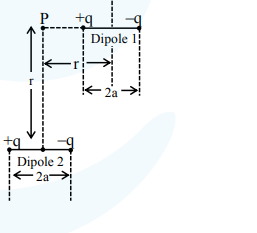
Two vertical dipoles are shown with point P above. Dipole 1 has +q on left and -q on right, P lies on its axis at distance r. Dipole 2 below has +q on left and -q on right, and P lies on its equatorial line at distance r. Separation of charges in each dipole is 2a.
  • A

    ar20\frac{a}{r} - 20

  • B

    ar10\frac{a}{r} \sim 10

  • C

    ar0.5\frac{a}{r} \sim 0.5

  • D

    ar3\frac{a}{r} \sim 3

Answer

Correct answer:D

Step-by-step solution

Standard Method

Given: A charge QQ is placed at point PP. Point PP lies on the axial line of Dipole 1 at distance rr and on the equatorial plane of Dipole 2 at distance rr. Each dipole has charges ±q\pm q separated by 2a2a.

Find: The condition on the ratio ar\frac{a}{r} for the net force on QQ to be zero.

From the solution, the correct option is marked as D.

Using the exact field balance written in the solution,

kq(ra)2=kq(r+a)2+2kqa(r2+a2)3/2\frac{kq}{(r-a)^2}=\frac{kq}{(r+a)^2}+\frac{2kqa}{(r^2+a^2)^{3/2}}

Rearranging,

1(ra)21(r+a)2=2a(r2+a2)3/2\frac{1}{(r-a)^2}-\frac{1}{(r+a)^2}=\frac{2a}{(r^2+a^2)^{3/2}}

Now simplify the left-hand side:

(r+a)2(ra)2(r2a2)2=2a(r2+a2)3/2\frac{(r+a)^2-(r-a)^2}{(r^2-a^2)^2}=\frac{2a}{(r^2+a^2)^{3/2}}

So,

4ra(r2a2)2=2a(r2+a2)3/2\frac{4ra}{(r^2-a^2)^2}=\frac{2a}{(r^2+a^2)^{3/2}}

Cancelling the common factor 2a2a,

2r(r2a2)2=1(r2+a2)3/2\frac{2r}{(r^2-a^2)^2}=\frac{1}{(r^2+a^2)^{3/2}}

Dimensionless Form from the Extracted Working

Squaring the relation given in the solution,

4r2(r2a2)4=1(r2+a2)3\frac{4r^2}{(r^2-a^2)^4}=\frac{1}{(r^2+a^2)^3}

Hence,

4r2(r2+a2)3=(r2a2)44r^2(r^2+a^2)^3=(r^2-a^2)^4

Let

x=arx=\frac{a}{r}

Then the equation becomes

4(1+x2)3=(1x2)44(1+x^2)^3=(1-x^2)^4

The extracted solution states that numerical analysis gives

x3x\approx 3

Therefore,

ar3\frac{a}{r}\approx 3

So the correct option is D.

Note: The solution is internally inconsistent in places and mentions a physical-realizability concern, but it explicitly marks Option D as correct and concludes ar3\frac{a}{r}\approx 3. Therefore the answer is taken as D.

Common mistakes

  • Using the far-field dipole formulas Eaxial1r3E_{\text{axial}}\propto \frac{1}{r^3} and Eequatorial1r3E_{\text{equatorial}}\propto \frac{1}{r^3} directly without checking whether they apply. Here the extracted solution uses exact charge-distance expressions, so using only approximate dipole formulas can give a wrong condition.

  • Adding magnitudes of fields without tracking directions. For zero net force, the vector directions of the fields at PP must oppose appropriately; otherwise equating unsigned values can produce an incorrect result.

  • Cancelling factors incorrectly while simplifying

    1(ra)21(r+a)2\frac{1}{(r-a)^2}-\frac{1}{(r+a)^2}

    This difference must be combined carefully over a common denominator; a sign mistake changes the final equation for ar\frac{a}{r}.

Practice more Electric Dipole questions

Get unlimited AI-adaptive practice, mastery tracking, and an AI tutor that explains every step — free to start.

Related questions