
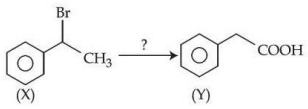
The correct sequence of reagents for the above conversion of X to Y is :
- A
(i) NaOH (ii) Jones reagent (iii)
- B
(i) NaOEt (ii) (iii) Jones reagent
- C
(i) (ii) NaOEt (iii) Jones reagent
- D
(i) Jones reagent (ii) NaOEt (iii) Hot
The correct sequence of reagents for the above conversion of X to Y is :
(i) NaOH (ii) Jones reagent (iii)
(i) NaOEt (ii) (iii) Jones reagent
(i) (ii) NaOEt (iii) Jones reagent
(i) Jones reagent (ii) NaOEt (iii) Hot
Correct answer:B
Standard Method
Given: Conversion of X to Y is shown.
Find: The correct sequence of reagents.
The solution states that the required strategy is to first form an alkene, then carry out anti-Markovnikov hydration, and finally oxidize the resulting primary alcohol.
The hint also states that Jones reagent is a strong oxidant that converts a primary alcohol into a carboxylic acid.
Therefore, the correct option is B.
Stepwise Functional Group Transformation
Given: X is an alkyl halide attached to a benzene side chain, and Y is the corresponding side-chain carboxylic acid.
Find: Which reagent sequence achieves this transformation.
Identify principle: The product requires oxidation at the terminal carbon, so an intermediate primary alcohol is needed before final oxidation.
Apply the sequence shown in the solution:
Hence the sequence is (i) NaOEt (ii) (iii) Jones reagent.
Therefore, the correct option is B.
Choosing Jones reagent in the first step is incorrect because it is an oxidizing agent, not a reagent for dehydrohalogenation. First form the alkene using NaOEt, then proceed further.
Using before alkene formation is incorrect because hydroboration-oxidation requires an alkene substrate. The elimination step must occur first.
Assuming the oxidation stops at an aldehyde is incorrect here. Jones reagent is a strong oxidant and takes a primary alcohol to the carboxylic acid.
Get unlimited AI-adaptive practice, mastery tracking, and an AI tutor that explains every step — free to start.