MCQMediumJEE 2025Alkyl Halides

JEE Chemistry 2025 Question with Solution

The major product of the following reaction is:
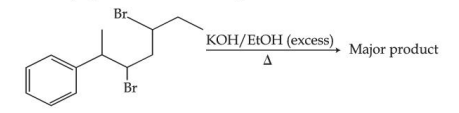
Reaction scheme showing a phenyl-substituted dibromo alkane treated with KOH in ethanol in excess under heat, asking for the major product.
  • A

    2-Phenylhepta-2,4-diene

  • B

    6-Phenylhepta-3,5-diene

  • C

    6-Phenylhepta-2,4-diene

  • D

    2-Phenylhepta-2,5-diene

Answer

Correct answer:C

Step-by-step solution

Standard Method

Given: The substrate is a phenyl-substituted dibromo compound treated with alcoholic KOH (excess) and heat.

Find: The major product formed after elimination.

Alcoholic KOH in excess with heating promotes double dehydrohalogenation. A vicinal dibromide undergoes two successive eliminations of HBr to form a diene.

The major product is the more stable conjugated diene because conjugation provides resonance stabilization.

From the reaction, the product formed is

C6H5CH=CHCH=CHCH2CH3\text{C}_6\text{H}_5\text{CH}=\text{CHCH}=\text{CHCH}_2\text{CH}_3

which corresponds to 6-Phenylhepta-2,4-diene.

Therefore, the correct option is C.

Stepwise Elimination Logic

Given: The reagent is KOH/EtOH (excess) with Δ\Delta.

Find: Which alkene framework is favored as the major product.

Step 1: Excess alcoholic KOH indicates an E2 elimination pathway.

Step 2: Since the substrate contains two bromine atoms, two molecules of HBr are removed in succession.

Step 3: The first elimination gives an alkene, and the second elimination gives a diene.

Step 4: Among possible dienes, the conjugated diene is favored over an isolated diene because conjugation is more stable by resonance.

Hence the final major product is 6-Phenylhepta-2,4-diene.

Therefore, the correct option is C.

Common mistakes

  • Choosing a non-conjugated diene such as 2-Phenylhepta-2,5-diene. This is incorrect because excess alcoholic KOH favors formation of the more stable conjugated elimination product. Prefer the diene with alternating double bonds.

  • Ignoring that the reaction is a double dehydrohalogenation. Removing only one molecule of HBr gives only an alkene intermediate, not the final major product. Use the presence of two bromine atoms and excess base to infer two eliminations.

  • Misnumbering the carbon chain and placing the phenyl group at the wrong position. The product name must match the actual longest chain and substituent location after elimination. Number the chain carefully before matching the option.

Practice more Alkyl Halides questions

Get unlimited AI-adaptive practice, mastery tracking, and an AI tutor that explains every step - free to start.

Related questions