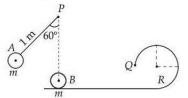
A small bob A of mass m is attached to a massless rigid rod of length 1m pivoted at point P and kept at an angle of 60∘ with vertical. At 1m below P, bob B is kept on a smooth surface. If bob B just manages to complete the circular path of radius R after being hit elastically by A, then radius R is _____ m :
A
53
B
52−3
C
51
D
52+3
Answer
Correct answer:C
Step-by-step solution
Standard Method
Given: Bob A of mass m is attached to a rigid rod of length 1m and released from 60∘ with the vertical. Bob B of equal mass is initially at rest. The collision is elastic, and bob B just completes a vertical circle of radius R.
Find: The value of R and the correct option.
From the swing of bob A, the loss in height is
h=L(1−cosθ)
With L=1m and θ=60∘,
h=1(1−cos60∘)=1(1−21)=21m
Using conservation of mechanical energy for bob A,
21mvA2=mghvA=2gh=2g⋅21=g
In an elastic collision between two equal masses, when one mass is initially at rest, the velocities are exchanged. Therefore bob B acquires speed
vB=g
For a particle to just complete a vertical circle of radius R, the minimum speed required at the lowest point is
vB=5gR
Hence,
g=5gR
Squaring both sides,
g=5gRR=51m
Therefore, the radius is 51m and the correct option is C.
Velocity Exchange Trick
Given: The masses of A and B are equal, and the collision is elastic.
Find: Use the quickest route to determine R.
First find the speed of bob A at the bottom from the vertical drop
h=1(1−cos60∘)=21
So,
vA=2gh=g
Now use the key trick: in a head-on elastic collision of two equal masses with one initially at rest, they exchange velocities. Hence immediately after collision,
vB=g
For just complete looping,
vbottom,min=5gR
So,
g=5gR⇒R=51
This works because the equal-mass elastic collision removes the need to separately solve momentum and restitution equations. Therefore, the correct option is C.
Common mistakes
Using v=2gR for complete vertical circular motion is incorrect because that condition applies to the top-point minimum speed relation, not the required bottom speed. Use vbottom,min=5gR instead.
Taking the height fallen by bob A as 1m is wrong. The bob falls only through h=L(1−cosθ), which here is 21m.
Ignoring that the masses are equal in an elastic collision leads to unnecessary equations or wrong post-collision speeds. For equal masses with one initially at rest, the moving bob transfers its velocity to the stationary bob.
Practice more Elastic & Inelastic Collisions questions
Get unlimited AI-adaptive practice, mastery tracking, and an AI tutor that explains every step — free to start.