MCQMediumJEE Main 2025 · 29 January, Shift 2Elastic & Inelastic Collisions

Physics Question from JEE Main 2025 · 29 January, Shift 2

Given below are two statements, one is labelled as Assertion (A) and the other is labelled as Reason (R).
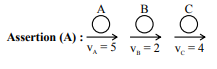
Three identical spheres A, B and C on a horizontal line, all moving to the right, with arrows labelled v_A = 5, v_B = 2 and v_C = 4.

Three identical spheres of the same mass undergo one-dimensional motion as shown in the figure with initial velocities vA=5m/s,vB=2m/s,vC=4m/sv_A = 5 \, \text{m/s}, v_B = 2 \, \text{m/s}, v_C = 4 \, \text{m/s}. If we wait sufficiently long for elastic collision to happen, then vA=4m/s,vB=2m/s,vC=5m/sv_A = 4 \, \text{m/s}, v_B = 2 \, \text{m/s}, v_C = 5 \, \text{m/s} will be the final velocities.

Reason (R): In an elastic collision between identical masses, two objects exchange their velocities.

In light of the above statements, choose the correct answer from the options given below:

  • A

    Both (A) and (R) are true but (R) is NOT the correct explanation of (A)

  • B

    (A) is true but (R) is false

  • C

    Both (A) and (R) are true and (R) is the correct explanation of (A)

  • D

    (A) is false but (R) is true

Answer & step-by-step solution

Sign in to reveal the correct answer, the full step-by-step solution, and the common mistakes for this question.

Practice more Elastic & Inelastic Collisions questions

Get unlimited AI-adaptive practice, mastery tracking, and an AI tutor that explains every step - free to start.

Related questions