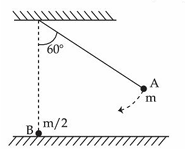
As shown below, bob A of a pendulum having massless string of length R is released from 60∘ to the vertical. It hits another bob B of half the mass that is at rest on a frictionless table in the center. Assuming elastic collision, the magnitude of the velocity of bob A after the collision will be (take g as acceleration due to gravity):
A
31Rg
B
Rg
C
32Rg
D
34Rg
Answer
Correct answer:A
Step-by-step solution
Standard Method
Given: Bob A of mass m is released from 60∘ to the vertical on a pendulum of length R. Bob B has mass 2m and is initially at rest. The collision is elastic.
Find: The magnitude of velocity of bob A after collision.
First find the speed of A just before collision using conservation of mechanical energy. The vertical drop from 60∘ is R−Rcos60∘=2R, so
u2=2g(2R)=gR
Hence, the speed just before impact is
u=gR
Let the velocities of A and B just after collision be v1 and v2 respectively.
Using conservation of momentum along the line of impact,
mν=mv1+2mv2
which gives
2v1+v2=2ν...(i)
Since the collision is elastic, coefficient of restitution e=1. Therefore,
e=νv2−v1=1
so
v2−v1=ν...(ii)
From equation (ii),
v2=v1+ν
Substitute into equation (i):
2v1+(v1+ν)=2ν3v1=νv1=3ν
Now substitute ν=gR:
v1=31gR
Therefore, the magnitude of velocity of bob A after collision is 31gR. The correct option is A.
The solution's lists option C in the answer key, but the extracted solution working and final boxed result give 31gR, so the solution has been followed.
Energy and restitution breakdown
Given: The pendulum bob starts from rest at 60∘ to the vertical and strikes a lighter bob at the lowest point.
Find: Speed of bob A after an elastic collision.
The height fallen by bob A is obtained from geometry:
h=R−Rcos60∘h=R−2R=2R
So just before collision,
mgh=21mν2mg(2R)=21mν2ν2=gRν=gR
Now apply the two collision relations:
Momentum conservation:
mν=mv1+2mv2
Elastic collision condition:
v2−v1=ν
These two equations are sufficient to determine v1 and v2.
Multiply the momentum equation by m2:
2ν=2v1+v2
Using v2=v1+ν,
2ν=2v1+v1+νν=3v1v1=3ν=31gR
Hence, bob A moves after collision with speed 31gR.
Common mistakes
Using the initial potential energy drop as mgR instead of mg2R. This is wrong because the bob is released from 60∘ to the vertical, so the actual drop is R(1−cos60∘)=2R. Always compute the vertical height change from geometry first.
Applying only conservation of momentum and ignoring elasticity. Momentum alone gives one equation with two unknown final speeds. For an elastic collision, also use e=1 or equivalently the relative speed condition.
Writing the restitution equation with the wrong sign, such as v1−v2=ν. This is incorrect because coefficient of restitution uses speed of separation over speed of approach along the line of impact, giving v2−v1=ν here.
Practice more Elastic & Inelastic Collisions questions
Get unlimited AI-adaptive practice, mastery tracking, and an AI tutor that explains every step — free to start.