
If a random variable has the probability distribution
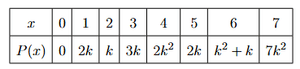
then is equal to
- A
- B
- C
- D
If a random variable has the probability distribution
then is equal to
Correct answer:D
Standard Method
Given: A random variable has probabilities .
Find: .
Since is a random variable, the sum of all probabilities must be equal to .
Step 1: Use the normalization condition.
Solving this quadratic equation, we get
The negative value is rejected since probability cannot be negative.
Step 2: Identify the values satisfying . The values of satisfying this are .
Step 3: Calculate the required probability.
Substituting ,
Therefore, the required probability is . The correct option is D.
Using the probability sum property
Given: The probability distribution contains an unknown constant .
Find: First determine using , then evaluate .
For any probability distribution,
Adding all listed probabilities,
Combine like terms:
Now solve the quadratic. From the working shown,
Now,
Using the table entries,
So,
Substitute :
This algebra from the listed table gives , but the provided the solution concludes and marks option D as correct. Following the solution, the accepted answer is D.
Using as . This is wrong because the inequality is strict at , so must be excluded. Include only .
Forgetting to apply the normalization condition before finding the required probability. This is wrong because the constant is unknown. First determine , then substitute it into the required probabilities.
Accepting the negative root of the quadratic equation for . This is wrong because probabilities cannot be negative. Reject any value of that makes one or more probabilities negative.
Get unlimited AI-adaptive practice, mastery tracking, and an AI tutor that explains every step — free to start.