
NVAMediumJEE 2026Gibbs Free Energy & Equilibrium Constant

JEE Chemistry 2026 Question with Solution

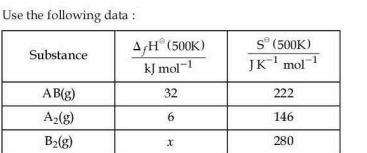
Table of thermodynamic data at 500 K for AB(g), A2(g), and B2(g), listing standard enthalpy and standard entropy values, with B2(g) enthalpy marked as x.

One mole each of A2(g)A_2(g) and B2(g)B_2(g) are taken in a 1L1 \, \text{L} closed flask and allowed to establish the equilibrium at 500K500 \, \text{K}: A2(g)+B2(g)2AB(g)A_{2}(g)+B_{2}(g) \rightleftharpoons 2AB(g). The value of xx (missing enthalpy of B2B_2 or related parameter) is _____ . (Nearest integer)

Answer

Correct answer:70

Step-by-step solution

Standard Method

Given: A2(g)+B2(g)2AB(g)A_2(g)+B_2(g) \rightleftharpoons 2AB(g) at 500K500 \, \text{K}. Also, logK=2.2\log K = 2.2, S(AB)=222J K1mol1S^\circ(AB)=222 \, \text{J K}^{-1} \text{mol}^{-1}, S(A2)=146J K1mol1S^\circ(A_2)=146 \, \text{J K}^{-1} \text{mol}^{-1}, S(B2)=280J K1mol1S^\circ(B_2)=280 \, \text{J K}^{-1} \text{mol}^{-1}, ΔfH(AB)=32kJ mol1\Delta_f H^\circ(AB)=32 \, \text{kJ mol}^{-1}, ΔfH(A2)=6kJ mol1\Delta_f H^\circ(A_2)=6 \, \text{kJ mol}^{-1}, and ΔfH(B2)=x\Delta_f H^\circ(B_2)=x.

Find: The value of xx.

From the solution data,

ΔG=2.303RTlogK\Delta G^\circ = -2.303RT \log K ΔG=2.303×8.3×500×2.2\Delta G^\circ = -2.303 \times 8.3 \times 500 \times 2.2 ΔG21027J/mol21kJ/mol\Delta G^\circ \approx -21027 \, \text{J/mol} \approx -21 \, \text{kJ/mol}

Now calculate the standard entropy change of reaction:

ΔSrxn=2S(AB)[S(A2)+S(B2)]\Delta S^\circ_{\text{rxn}} = 2S^\circ(AB) - \left[S^\circ(A_2) + S^\circ(B_2)\right] ΔSrxn=2(222)(146+280)=444426=18J K1mol1\Delta S^\circ_{\text{rxn}} = 2(222) - (146 + 280) = 444 - 426 = 18 \, \text{J K}^{-1} \text{mol}^{-1}

Using

ΔG=ΔHTΔS\Delta G^\circ = \Delta H^\circ - T\Delta S^\circ 21000=ΔH500(18)-21000 = \Delta H^\circ - 500(18) 21000=ΔH9000-21000 = \Delta H^\circ - 9000 ΔH=12000J/mol=12kJ/mol\Delta H^\circ = -12000 \, \text{J/mol} = -12 \, \text{kJ/mol}

For the reaction enthalpy,

ΔHrxn=2ΔH(AB)[ΔH(A2)+HB2]\Delta H^\circ_{\text{rxn}} = 2\Delta H(AB) - \left[\Delta H(A_2) + H_{B_2}\right] 12=2(32)(6+HB2)-12 = 2(32) - (6 + H_{B_2}) 12=646HB2-12 = 64 - 6 - H_{B_2} 12=58HB2-12 = 58 - H_{B_2} HB2=70kJ/molH_{B_2} = 70 \, \text{kJ/mol}

Therefore, the value of xx is 7070.

The answer key shows 2626, but the extracted solution working concludes 7070, so the solution is taken as authoritative.

Thermodynamic Relation Breakdown

Given: Equilibrium data at 500K500 \, \text{K} and thermodynamic table values.

Find: Missing enthalpy value xx for B2(g)B_2(g).

  1. First convert equilibrium information into free energy change:
ΔG=2.303RTlogK\Delta G^\circ = -2.303RT \log K

Substituting the given values:

ΔG=2.303×8.3×500×2.221kJ/mol\Delta G^\circ = -2.303 \times 8.3 \times 500 \times 2.2 \approx -21 \, \text{kJ/mol}
  1. Next compute reaction entropy:
ΔSrxn=2(222)(146+280)=18J K1mol1\Delta S^\circ_{\text{rxn}} = 2(222) - (146+280) = 18 \, \text{J K}^{-1} \text{mol}^{-1}

This is

18J K1mol1=0.018kJ K1mol118 \, \text{J K}^{-1} \text{mol}^{-1} = 0.018 \, \text{kJ K}^{-1} \text{mol}^{-1}
  1. Use the relation
ΔG=ΔHTΔS\Delta G^\circ = \Delta H^\circ - T\Delta S^\circ

So,

ΔH=ΔG+TΔS\Delta H^\circ = \Delta G^\circ + T\Delta S^\circ ΔH=21+500(0.018)=21+9=12kJ/mol\Delta H^\circ = -21 + 500(0.018) = -21 + 9 = -12 \, \text{kJ/mol}
  1. Express reaction enthalpy in terms of formation enthalpies:
ΔHrxn=2ΔfH(AB)[ΔfH(A2)+ΔfH(B2)]\Delta H^\circ_{\text{rxn}} = 2\Delta_f H^\circ(AB) - \left[\Delta_f H^\circ(A_2) + \Delta_f H^\circ(B_2)\right] 12=2(32)(6+x)-12 = 2(32) - (6 + x) 12=646x=58x-12 = 64 - 6 - x = 58 - x x=70x = 70

Therefore, the nearest integer value is 7070.

Common mistakes

  • Using the answer key 2626 without checking the solution working. Here the thermodynamic steps in the solution clearly give x=70x=70. Always prioritize consistent derivation over a conflicting listed answer.

  • Forgetting to convert ΔS\Delta S^\circ from J K1mol1\text{J K}^{-1} \text{mol}^{-1} to kJ K1mol1\text{kJ K}^{-1} \text{mol}^{-1} before combining it with enthalpy in kJ/mol\text{kJ/mol}. This causes unit inconsistency. Convert first or work entirely in joules.

  • Writing the reaction enthalpy expression with incorrect signs for reactants and products. Use ΔHrxn=ΔHf(products)ΔHf(reactants)\Delta H^\circ_{\text{rxn}} = \sum \Delta H_f^\circ(\text{products}) - \sum \Delta H_f^\circ(\text{reactants}).

Practice more Gibbs Free Energy & Equilibrium Constant questions

Get unlimited AI-adaptive practice, mastery tracking, and an AI tutor that explains every step — free to start.

Related questions