MCQMediumJEE 2026Gibbs Free Energy & Equilibrium Constant

JEE Chemistry 2026 Question with Solution

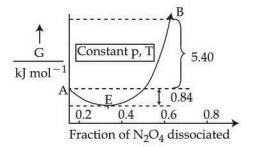
For the reaction, N2O42NO2N_{2}O_{4} \rightleftharpoons 2NO_{2} graph is plotted as shown below. Identify correct statements.

A. Standard free energy change for the reaction is 5.40kJ mol15.40 \, \text{kJ mol}^{-1}.

B. As ΔG\Delta G in graph is positive, N2O4N_{2}O_{4} will not dissociate into NO2NO_{2} at all.

C. Reverse reaction will go to completion.

D. When 11 mole of N2O4N_{2}O_{4} changes into equilibrium mixture, value of ΔG=0.84kJ mol1\Delta G = -0.84 \, \text{kJ mol}^{-1}**.

E. When 22 mole of NO2NO_{2} changes into equilibrium mixture, ΔG\Delta G for equilibrium mixture is 6.24kJ mol1-6.24 \, \text{kJ mol}^{-1}.

Choose the correct answer from the following.**

Graph of Gibbs free energy G in kJ mol inverse versus fraction of N2O4 dissociated, showing points B and E, equilibrium minimum, and marked values 5.40 and 0.84 under constant pressure and temperature.
  • A

    B and C only

  • B

    A and D only

  • C

    D and E only

  • D

    C and E only

Answer

Correct answer:B

Step-by-step solution

Standard Method

Given: The graph shows Gibbs free energy GG versus fraction of N2O4N_{2}O_{4} dissociated for N2O42NO2N_{2}O_{4} \rightleftharpoons 2NO_{2} at constant p,Tp, T.

Find: Which statements are correct.

From the graph, the equilibrium point is the minimum of the GG curve. The labeled changes are:

  • From pure reactants to equilibrium: 0.84kJ mol1-0.84 \, \text{kJ mol}^{-1}
  • From pure products to equilibrium: 6.24kJ mol1-6.24 \, \text{kJ mol}^{-1}

For standard free energy change,

ΔG=G(products)G(reactants)\Delta G^{\circ} = G^{\circ}(\text{products}) - G^{\circ}(\text{reactants})

Using the graph values,

Gproducts=Geq+6.24G_{\text{products}} = G_{eq} + 6.24 Greactants=Geq+0.84G_{\text{reactants}} = G_{eq} + 0.84

Therefore,

ΔG=(Geq+6.24)(Geq+0.84)=5.40kJ mol1\Delta G^{\circ} = (G_{eq} + 6.24) - (G_{eq} + 0.84) = 5.40 \, \text{kJ mol}^{-1}

So statement A is correct.

Since the minimum of GG occurs at an intermediate composition, the system moves spontaneously toward equilibrium from either side, but does not go to completion in either direction. Hence statements B and C are incorrect.

Starting from 11 mole of N2O4N_{2}O_{4}, the change in free energy to reach equilibrium is read from the graph as

ΔG=0.84kJ mol1\Delta G = -0.84 \, \text{kJ mol}^{-1}

So statement D is correct.

The solution states that statement E is also physically correct because starting from 22 moles of NO2NO_{2}, the free energy change to equilibrium is

ΔG=6.24kJ mol1\Delta G = -6.24 \, \text{kJ mol}^{-1}

However, this creates a mismatch with the provided options, since the option set does not include A, D, E together. The source solution explicitly concludes that the intended answer is Option B based on statements A and D.

Therefore, the correct option is B.

Statement-wise Evaluation

Given: A GG versus fraction dissociated graph for N2O42NO2N_{2}O_{4} \rightleftharpoons 2NO_{2}.

Find: Check each statement using the graph.

  1. Statement A
ΔG=GproductsGreactants=6.240.84=5.40kJ mol1\Delta G^{\circ} = G_{\text{products}} - G_{\text{reactants}} = 6.24 - 0.84 = 5.40 \, \text{kJ mol}^{-1}

So A is correct.

  1. Statement B A positive ΔG\Delta G for a particular state does not mean dissociation never occurs. It only indicates the direction of spontaneous change from that state. The graph minimum lies away from pure N2O4N_{2}O_{4}, so some dissociation does occur. Thus B is incorrect.
  1. Statement C If the reverse reaction went to completion, the minimum would be at one extreme. Since the minimum is at an intermediate composition, completion does not occur. Thus C is incorrect.
  1. Statement D From pure N2O4N_{2}O_{4} to equilibrium,
ΔG=0.84kJ mol1\Delta G = -0.84 \, \text{kJ mol}^{-1}

So D is correct.

  1. Statement E From pure 2NO22NO_{2} to equilibrium,
ΔG=6.24kJ mol1\Delta G = -6.24 \, \text{kJ mol}^{-1}

So the statement appears correct from the graph, but the official solution selects B because the intended keyed combination is A and D only.

Hence, following the source solution authority, the correct option is B.

Common mistakes

  • Assuming a positive ΔG\Delta G at some point means the reaction will not occur at all. This is wrong because ΔG\Delta G decides spontaneity from a specific state toward equilibrium, not whether reaction is possible. Always check where the minimum of the GG curve lies.

  • Confusing ΔG\Delta G with ΔG\Delta G^{\circ}. This is wrong because ΔG\Delta G^{\circ} compares standard-state reactants and products, while ΔG\Delta G for the graph refers to moving from a chosen composition to equilibrium. Use the correct definition before calculating.

  • Concluding that a reaction goes to completion because one side has higher free energy. This is wrong because equilibrium is identified by the minimum of the curve, which here occurs at an intermediate composition. Check the location of the minimum, not only the endpoints.

Practice more Gibbs Free Energy & Equilibrium Constant questions

Get unlimited AI-adaptive practice, mastery tracking, and an AI tutor that explains every step — free to start.

Related questions