
When
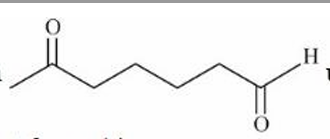
undergoes intramolecular aldol condensation, the major product formed is:
- A
Option 1
- B
Option 2
- C
Option 3
- D
Option 4
When
undergoes intramolecular aldol condensation, the major product formed is:
Option 1
Option 2
Option 3
Option 4
Correct answer:C
Standard Method
Given: The substrate undergoes intramolecular aldol condensation.
Find: The major cyclic product formed.
The solution explains that the given compound contains two carbonyl groups and forms an enolate at an -position. In an intramolecular aldol reaction, the enolate attacks the other carbonyl group within the same molecule, so cyclization occurs.
A -membered ring is favored because intramolecular aldol condensations usually prefer formation of - or -membered rings, and here the -membered cyclic product is stated to be the major product.
After cyclization, the intermediate -hydroxy carbonyl compound undergoes dehydration to give an -unsaturated carbonyl compound.
Therefore, the major product is the cyclic -unsaturated carbonyl compound with a -membered ring. The solution identifies this as option C.
The correct option is C.
Mechanistic Explanation
Given: An intramolecular aldol condensation of a dicarbonyl compound.
Find: Which option represents the major product.
The extracted solution states the following sequence:
Because ring closure that gives a -membered ring is more stable, that pathway dominates over alternatives. The final product is therefore a conjugated cyclic enone/enal-type product formed after dehydration.
The source solution explicitly concludes: the correct answer is the third option, and the page marks The Correct Option is C.
Choosing a product with the wrong ring size. Intramolecular aldol condensation usually favors - or -membered rings, so larger or strained alternatives are less likely. Check the carbon count during cyclization before selecting the product.
Forgetting the dehydration step. The aldol addition intermediate is a -hydroxy carbonyl compound, but the final major product of aldol condensation is typically the -unsaturated carbonyl compound. Do not stop at the addition product.
Forming the enolate at an inappropriate position. Only -hydrogens next to the carbonyl are enolizable in this mechanism. Identify the correct enolate-forming site first, then trace the intramolecular attack.
Get unlimited AI-adaptive practice, mastery tracking, and an AI tutor that explains every step — free to start.