
Identify the structure of the final product (D) in the following sequence of the reactions :
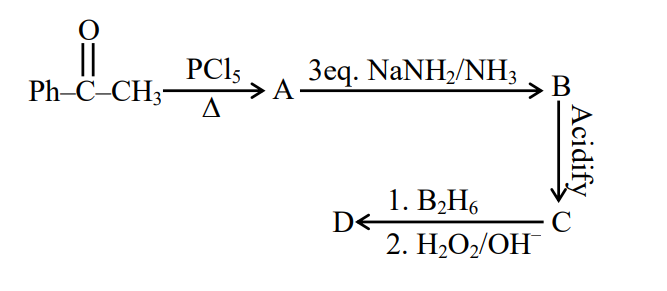
Total number of hybridised carbon atoms in product is _____.
Identify the structure of the final product (D) in the following sequence of the reactions :
Total number of hybridised carbon atoms in product is _____.
Correct answer:7
Standard Method
Given: A reaction sequence starts from acetophenone and forms product after treatment with , excess , acidification, and then hydroboration-oxidation.
Find: The total number of hybridised carbon atoms in product .
From the extracted solution sequence:
The relevant transformation shown is:
So the alkyne intermediate is .
Hydroboration-oxidation followed by tautomerization gives:
Thus, product is 1-phenylpropan-1-one / propiophenone-type ketone structure as extracted in the solution working, and the count of carbons is obtained directly from this structure.
Now count the hybridised carbons:
Therefore,
So, the total number of hybridised carbon atoms in product is .
Stepwise Extraction from the Given Solution
Given: The reaction sequence and the worked solution indicate successive conversion of acetophenone into intermediates , , and finally .
Find: Number of hybridised carbon atoms in .
Step 1: Formation of
The carbonyl group is converted into a geminal dichloride.
Step 2: Formation of
Double dehydrohalogenation gives an alkyne.
Step 3: Formation of Acidification does not alter the carbon skeleton here, so remains the same alkyne.
Step 4: Formation of Hydroboration-oxidation of the alkyne, followed by tautomerization, gives the ketone:
Step 5: Count carbons in The structure contains:
Hence,
Therefore, the required numerical answer is .
The first provided approach contains structural inconsistencies in the intermediate/product naming, but it also concludes the same final count. The second worked approach provides the defensible reaction sequence and is used for the answer determination.
Assuming that every carbon in the side chain after hydroboration-oxidation is . This is incorrect because only the carbonyl carbon is in the final ketone; the and carbons are . Always inspect each carbon individually.
Counting the phenyl ring incorrectly as fewer than carbons. In a benzene ring, all six ring carbons are hybridised. Do not exclude the ipso carbon attached to the side chain.
Stopping at the alkyne intermediate and counting carbons instead of the final product . The question asks for product after the complete sequence, so hybridisation must be counted only in the final structure.
Get unlimited AI-adaptive practice, mastery tracking, and an AI tutor that explains every step — free to start.