MCQMediumJEE 2025Isomerism (Structural, Stereoisomerism)

JEE Chemistry 2025 Question with Solution

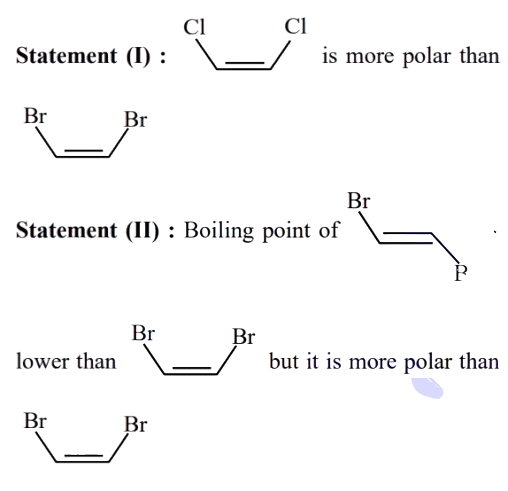
Given below are two statements :

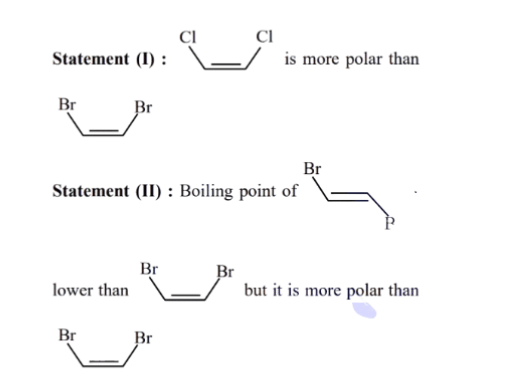
Figure showing Statement I and Statement II with structures of dichloroethene and dibromoethene isomers compared for polarity and boiling point.

In the light of the above statements, choose the most appropriate answer from the options given below :

  • A

    Statement I is correct but statement II is incorrect

  • B

    Statement I is incorrect but statement II is correct

  • C

    Both statement I and statement II are incorrect

  • D

    Both statement I and statement II are correct

Answer

Correct answer:A

Step-by-step solution

Standard Method

Given: Two statements based on the structures shown in the figure are to be checked for correctness.

Find: Which option correctly identifies the truth values of Statement I and Statement II.

To determine the correctness of the statements, let's analyze each one.

Solution figure showing cis-1,2-dichloroethene, cis-1,2-dibromoethene, and dibromoethene isomers compared for polarity and boiling point.
  1. Statement I: The structure with chlorine atoms is more polar than the structure with bromine atoms.
  • Chlorine is more electronegative than bromine.
  • Higher electronegativity makes the C–Cl bond more polar than the C–Br bond.
  • For the cis isomers shown, the bond dipoles add to give a net dipole moment.
  • Hence, Statement I is correct.
  1. Statement II: The boiling point comparison and polarity comparison given in the figure must both be checked exactly as written.
  • Boiling point depends on intermolecular forces and molecular mass.
  • The comparison involving dibromo compounds suggests that the heavier and more strongly interacting form would have the higher boiling point.
  • However, as written in the figure, the polarity comparison is flawed because the displayed comparison is incorrect/meaningless due to the structure shown.
  • The solution notes that the figure contains a typo, so Statement II is incorrect as presented.

Therefore, Statement I is correct but Statement II is incorrect. The correct option is A.

Detailed Analysis of Both Statements

Given: The question compares polarity and boiling point of halogen-substituted ethene isomers.

Find: The most appropriate option based on the exact statements shown in the figure.

Step 1: Analyze Statement I. The C–Cl bond is more polar than the C–Br bond because chlorine is more electronegative than bromine. In the cis isomers, the bond dipoles do not cancel completely, so the molecule has a net dipole moment. Therefore, cis-1,2-dichloroethene is more polar than cis-1,2-dibromoethene. So Statement I is correct.

Step 2: Analyze Statement II. The first part concerns boiling point. A polar isomer generally shows stronger dipole-dipole interactions than a comparable nonpolar isomer, and heavier bromine-containing molecules also show stronger dispersion forces.

The second part of Statement II, however, is incorrect as written in the figure. The solution indicates that the structure comparison contains a typo, so the polarity comparison is not valid in the displayed form. Even if the intended chemical idea may be reasonable, the statement must be judged from the actual figure shown.

Therefore, Statement II is incorrect as presented.

Step 3: Conclude. Thus, Statement I is correct but Statement II is incorrect.

The correct option is A, which corresponds to option (1).

Common mistakes

  • Assuming a chemically intended comparison instead of reading the figure exactly as given. In assertion-statement questions, a typo or wrong structural comparison makes the statement incorrect even if the underlying concept is correct. Always judge the statement as printed.

  • Thinking that a heavier halogen automatically decides polarity. Polarity depends on bond dipole and molecular geometry, not only on atomic mass. Compare electronegativity and dipole cancellation carefully.

  • Ignoring cis-trans geometry in dipole comparisons. In such molecules, cis isomers can have a net dipole moment, while trans isomers may show cancellation. Always inspect vector addition of bond dipoles before concluding polarity.

Practice more Isomerism (Structural, Stereoisomerism) questions

Get unlimited AI-adaptive practice, mastery tracking, and an AI tutor that explains every step — free to start.

Related questions