
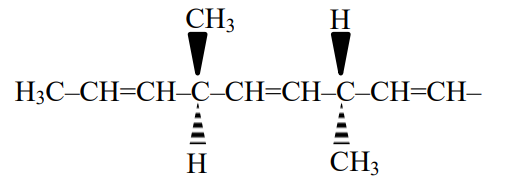
The number of optically active products obtained from the complete ozonolysis of the given compound is :
- A
- B
- C
- D
The number of optically active products obtained from the complete ozonolysis of the given compound is :
Correct answer:B
Standard Method
Given: The compound shown undergoes complete ozonolysis.
Find: The number of optically active products formed.
Principle: Ozonolysis cleaves each bond to give carbonyl compounds. After cleavage, each product must be checked for the presence or absence of a chiral center.
From the solution working, the organic products formed on complete ozonolysis are:
Now examine optical activity:
Thus, the number of optically active products is .
Therefore, the correct option is B.
Chirality-Based Counting
Given: A chiral polyene is subjected to complete ozonolysis.
Find: How many products are optically active.
Step 1: In ozonolysis, every bond is cleaved and converted into aldehyde or ketone groups.
Step 2: The extracted solution states that after cleavage the products include ethanal, glyoxal, and two products having asymmetric carbon centers.
Step 3: Optical activity depends on chirality, not merely on the number of fragments formed.
Conclusion: Exactly products are optically active. Hence, the correct option is B.
Counting all ozonolysis fragments as optically active is incorrect because optical activity requires chirality. First identify which products actually contain an asymmetric carbon center.
Assuming that every carbonyl product formed from ozonolysis is achiral is incorrect. Some cleavage products can still retain or generate a chiral center. Check each product individually.
Confusing the number of products with the number of optically active products leads to overcounting. Only the chiral products should be included in the final count.
Get unlimited AI-adaptive practice, mastery tracking, and an AI tutor that explains every step — free to start.