MCQMediumJEE 2025Alkenes (Electrophilic Addition, Polymerisation)

JEE Chemistry 2025 Question with Solution

The reactions which cannot be applied to prepare an alkene by elimination, are
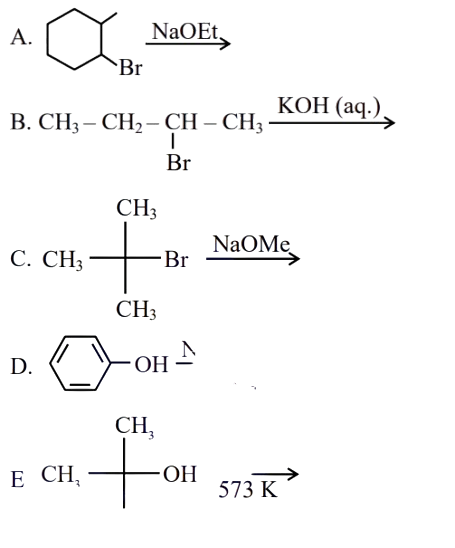
Five labeled reactions A to E are shown: alkyl halide with NaOEt, bromoalkane with aqueous KOH, tert-butyl bromide with NaOMe, phenol oxidation setup, and alcohol heated at 573 K.

Choose the correct answer from the options given below:

  • A

    B & E Only

  • B

    B, C & D Only

  • C

    A, C & D Only

  • D

    B & D Only

Answer

Correct answer:D

Step-by-step solution

Standard Method

Given: Five reactions A to E are shown, and we must identify which reactions cannot be applied to prepare an alkene by elimination.

Find: The correct option containing the reactions that do not give alkene formation by elimination.

Elimination reactions generally remove a small molecule such as HX\text{HX} or H2O\text{H}_2\text{O} from adjacent atoms to form a double bond.

From the provided solution:

  1. Reaction A uses NaOEt, a strong base, so dehydrohalogenation can occur. It is a valid elimination reaction.
  2. Reaction B uses KOH(aq), which generally favors nucleophilic substitution rather than elimination in this context. So it is not suitable here for preparing an alkene by elimination.
  3. Reaction C uses NaOMe, a strong base that promotes elimination. So it is a valid elimination reaction.
  4. Reaction D is described as an oxidation-type process and not an elimination route to an alkene. So it is not suitable.
  5. Reaction E at 573K573 \, \text{K} is a dehydration/elimination process and is valid for alkene preparation.

Therefore, the reactions that cannot be applied are B and D.

The correct option is D.

Solution figure showing the same five labeled reactions A to E with reagents NaOEt, KOH aqueous, NaOMe, oxidizing conditions for phenol, and alcohol heated at 573 K.

Stepwise Review of Each Reaction

Given: Reactions A to E.

Find: Which reactions cannot be used to prepare an alkene by elimination.

Step 1: Reaction A NaOEt is a strong base and commonly causes dehydrohalogenation. So A is a valid elimination reaction.

Step 2: Reaction B KOH(aq) usually favors substitution over elimination under these conditions. So B is not normally used here to prepare an alkene by elimination.

Step 3: Reaction C NaOMe is a strong base and can abstract a β\beta-hydrogen to give elimination. So C is valid.

Step 4: Reaction D This reaction proceeds through oxidation-related chemistry rather than elimination to an alkene. So D is not valid for alkene preparation by elimination.

Step 5: Reaction E Heating the alcohol at 573K573 \, \text{K} gives dehydration, which is a standard elimination route to an alkene. So E is valid.

Hence, the invalid reactions are B and D.

Therefore, the correct option is D.

The answer key and the solution conclusion agree.

Common mistakes

  • Assuming every reaction with a base gives elimination. This is wrong because aqueous KOH often favors substitution instead. Check whether the reagent and medium support elimination or nucleophilic substitution.

  • Treating oxidation and elimination as the same type of transformation. This is wrong because oxidation changes oxidation state, whereas elimination removes groups to create a double bond. Identify the reaction class before selecting the option.

  • Ignoring that heating an alcohol can lead to dehydration. This is wrong because dehydration is a standard elimination pathway to form alkenes. Look for loss of H2O\text{H}_2\text{O} under high-temperature conditions.

Practice more Alkenes (Electrophilic Addition, Polymerisation) questions

Get unlimited AI-adaptive practice, mastery tracking, and an AI tutor that explains every step — free to start.

Related questions