
Match List-I with List-II
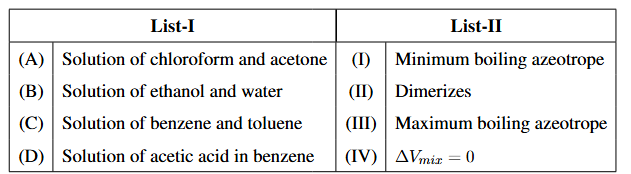
Choose the correct answer from the options given below :
- A
(A)-(III), (B)-(I), (C)-(IV), (D)-(II)
- B
(A)-(II), (B)-(IV), (C)-(I), (D)-(III)
- C
(A)-(III), (B)-(IV), (C)-(I), (D)-(II)
- D
(A)-(II), (B)-(I), (C)-(IV), (D)-(III)
Match List-I with List-II
Choose the correct answer from the options given below :
(A)-(III), (B)-(I), (C)-(IV), (D)-(II)
(A)-(II), (B)-(IV), (C)-(I), (D)-(III)
(A)-(III), (B)-(IV), (C)-(I), (D)-(II)
(A)-(II), (B)-(I), (C)-(IV), (D)-(III)
Correct answer:A
Standard Method
Given: A matching problem based on properties of solutions and deviations from Raoult's law.
Find: The correct correspondence between List-I and List-II.
For the listed pairs:
Solution of chloroform and acetone shows strong hydrogen bonding between chloroform and acetone. Stronger intermolecular attraction causes negative deviation from Raoult's law, so it forms a maximum boiling azeotrope. Therefore, (A) (\to) (III).
Solution of ethanol and water shows positive deviation from Raoult's law and forms a minimum boiling azeotrope. Therefore, (B) (\to) (I).
Solution of benzene and toluene behaves nearly ideally because the intermolecular forces are similar. For an ideal solution,
Therefore, (C) (\to) (IV).
Thus, the correct arrangement is (A)-(III), (B)-(I), (C)-(IV), (D)-(II).
Therefore, the correct option is A.
Concept-Based Matching
Given: Four solutions are to be matched with their characteristic behaviors.
Find: The correct matching pair set.
Step 1: Analyze chloroform + acetone.
Chloroform and acetone exhibit strong hydrogen bonding. This makes the escaping tendency of molecules smaller than expected, causing negative deviation from Raoult's law. Such solutions form a maximum boiling azeotrope.
So, (A) (\to) (III).
Step 2: Analyze ethanol + water.
This mixture shows positive deviation from Raoult's law and hence forms a minimum boiling azeotrope.
So, (B) (\to) (I).
Step 3: Analyze benzene + toluene.
These are structurally similar non-polar liquids with similar intermolecular forces. Hence, the solution behaves nearly ideally, and for an ideal solution,
So, (C) (\to) (IV).
Step 4: Analyze acetic acid in benzene.
In a non-polar solvent like benzene, acetic acid associates through hydrogen bonding and forms dimers.
So, (D) (\to) (II).
Step 5: Write the final matching.
(A)-(III), (B)-(I), (C)-(IV), (D)-(II)
Therefore, the correct option is A.
Confusing positive deviation with maximum boiling azeotrope is incorrect because positive deviation increases vapour pressure and leads to a minimum boiling azeotrope. Always relate stronger interactions to negative deviation and weaker interactions to positive deviation.
Assuming benzene and toluene form a non-ideal solution is incorrect because their intermolecular forces are very similar. Treat this pair as nearly ideal and use .
Missing the dimerization of acetic acid in benzene is a conceptual error because acetic acid associates in non-polar solvents through hydrogen bonding. Do not treat it as existing only as monomer molecules in benzene.
Get unlimited AI-adaptive practice, mastery tracking, and an AI tutor that explains every step — free to start.