
"P" is an optically active compound with molecular formula . When "P" is treated with 2,4-dinitrophenylhydrazine, it gives a positive test. However, in presence of Tollens reagent, "P" gives a negative test. Predict the structure of "P".
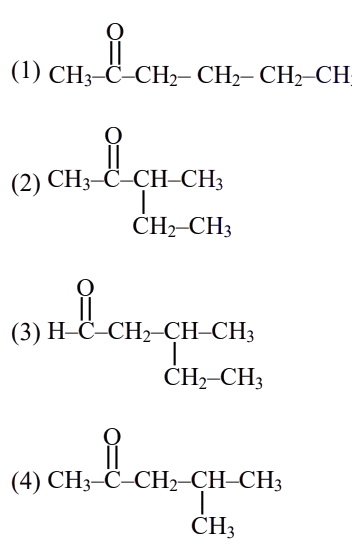
- A
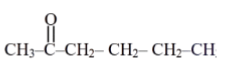
- B
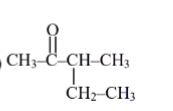
- C
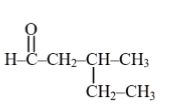
- D
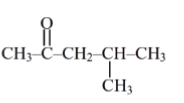
"P" is an optically active compound with molecular formula . When "P" is treated with 2,4-dinitrophenylhydrazine, it gives a positive test. However, in presence of Tollens reagent, "P" gives a negative test. Predict the structure of "P".
Correct answer:B
Standard Method
Given: "P" has molecular formula , gives a positive test with 2,4-dinitrophenylhydrazine, and a negative test with Tollens reagent. It is also optically active.
Find: The correct structure of "P".
A positive 2,4-DNP test shows that the compound contains a carbonyl group, so it must be an aldehyde or a ketone.
A negative Tollens test rules out an aldehyde. Therefore, "P" must be a ketone.
Now use the condition of optical activity. An optically active compound must have a chiral carbon bonded to four different groups.
Among the given structures:
Therefore, the only structure satisfying all conditions is option B. The compound is 3-methyl-2-pentanone.
Detailed Elimination
Given: Molecular formula , positive 2,4-DNP test, negative Tollens test, and the compound is optically active.
Find: Which option matches all these observations.
Step 1: Use the formula. The degree of unsaturation is
So the molecule has one degree of unsaturation. Since 2,4-DNP is positive, that unsaturation is due to a carbonyl group.
Step 2: Distinguish aldehyde and ketone. Tollens reagent gives a positive test with aldehydes but not with ordinary ketones. Since the test is negative, the compound must be a ketone.
Step 3: Use optical activity. Optical activity requires chirality, so the molecule must contain a carbon attached to four different substituents.
Step 4: Check each option.
Thus only option B satisfies all the conditions.
Therefore, the correct option is B.
Assuming a positive 2,4-DNP test proves the compound is an aldehyde. This is wrong because 2,4-DNP gives a positive test for both aldehydes and ketones. Use Tollens reagent next to distinguish them.
Checking only for the carbonyl group and ignoring optical activity. This is wrong because several ketones may satisfy the carbonyl test, but only a chiral ketone can be optically active. Always inspect for a stereocenter.
Mistaking a branched carbon for a chiral center without comparing all four attached groups. This is wrong because a carbon is chiral only if all four substituents are different. Write the four groups explicitly before deciding.
Get unlimited AI-adaptive practice, mastery tracking, and an AI tutor that explains every step — free to start.