
Which of the following compounds is least likely to give effervescence of in presence of aq. ?
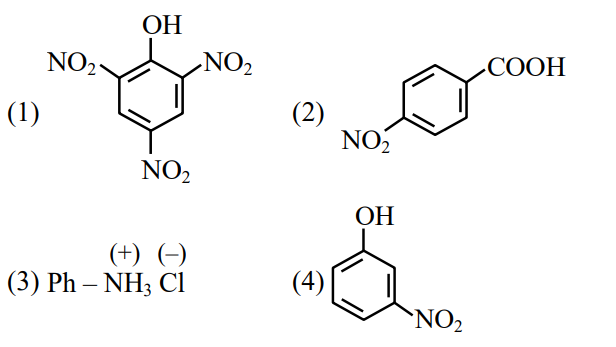
- A
- B
- C
- D
Which of the following compounds is least likely to give effervescence of in presence of aq. ?
Correct answer:D
Standard Method
Given: We must identify which compound is least likely to give effervescence of with aqueous .
Find: The correct option among the four given structures.
Sodium bicarbonate gives effervescence with compounds that are sufficiently acidic to liberate .
Carboxylic acids react readily with , whereas ordinary phenols generally do not. A more strongly acidic phenol such as trinitrophenol can react, but a simple nitrophenol is much less likely to do so.
From the given structures:
Therefore, the correct option is D.

Acidity Comparison
Given: Effervescence with aqueous is used to test whether a compound is acidic enough to produce .
Find: Which given compound is least likely to show this behavior.
Principle:
So we compare the acidic character of the four compounds shown.
The solution states that the correct option is D, corresponding to option .
Hence, the compound in option is least likely to give effervescence of in presence of aqueous .
Assuming every compound containing will react with . This is incorrect because ordinary phenols are not acidic enough. Check whether the group is a carboxylic acid or an unusually acidic phenol.
Focusing only on the presence of nitrogen or chlorine and ignoring acidity. The test depends on acid strength, not merely heteroatoms. Compare which structure can protonate bicarbonate effectively.
Treating option and option as similar because both contain an aromatic ring and one electron-withdrawing group. This is wrong because option has , which reacts readily with , whereas option is a nitrophenol.
Get unlimited AI-adaptive practice, mastery tracking, and an AI tutor that explains every step — free to start.