MCQMediumJEE 2026Phenols

JEE Chemistry 2026 Question with Solution

Consider the following sequence of reactions:
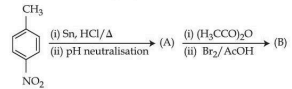
Reaction scheme starting from 4-nitrotoluene with CH3 para to NO2, then reagents Sn, HCl, water and pH neutralisation to give A, followed by acetic anhydride and bromine in acetic acid to give B.

4-nitrotoluene Assuming that the reaction proceeds to completion, then 137mg137 \, \text{mg} of 4-nitrotoluene will produce _____ mg\text{mg} of B. (Given molar mass in g mol1\text{g mol}^{-1} H: 11, C: 1212, N: 1414, O: 1616, Br: 8080)

  • A

    301301

  • B

    208208

  • C

    228228

  • D

    146146

Answer

Correct answer:C

Step-by-step solution

Standard Method

Given: The sequence involves reduction of the nitro group, acetylation of the amine formed, and then bromination.

Find: The mass of B obtained from 137mg137 \, \text{mg} of 4-nitrotoluene.

From the reaction sequence:

  1. NO2-NO_2 is reduced by Sn/HCl\text{Sn/HCl} to NH2-NH_2.
  2. Ac2O\text{Ac}_2\text{O} converts NH2-NH_2 to NHCOCH3-NHCOCH_3 to form A.
  3. Br2/AcOH\text{Br}_2/\text{AcOH} brominates the ring ortho to the activating acetamido group to form B.

The NHCOCH3-NHCOCH_3 group is ortho/para directing. Since the para position is occupied by the methyl group, bromine enters the ortho position.

Molar mass of 4-nitrotoluene (C7H7NO2)(C_7H_7NO_2):

7(12)+7(1)+14+2(16)=84+7+14+32=1377(12) + 7(1) + 14 + 2(16) = 84 + 7 + 14 + 32 = 137

So, its molar mass is 137g/mol137 \, \text{g/mol}.

Molar mass of B (C9H10NOBr)(C_9H_{10}NOBr):

9(12)+10(1)+14+16+80=108+10+14+16+80=2289(12) + 10(1) + 14 + 16 + 80 = 108 + 10 + 14 + 16 + 80 = 228

So, its molar mass is 228g/mol228 \, \text{g/mol}.

Since the stoichiometry is 1:11:1 throughout the sequence:

137mg of reactant=1mmol of 4-nitrotoluene137 \, \text{mg of reactant} = 1 \, \text{mmol of 4-nitrotoluene}

Therefore, it gives 1mmol1 \, \text{mmol} of B.

Mass of B:

1mmol×228mg/mmol=228mg1 \, \text{mmol} \times 228 \, \text{mg/mmol} = 228 \, \text{mg}

Product Identification and Mass Relation

Given: The starting compound is 4-nitrotoluene and the reaction proceeds to completion.

Find: The product identity of B and its mass.

The first step reduces 4-nitrotoluene to 4-methylaniline. The second step acetylates it to give 4-methylacetanilide (A). In the final step, bromination occurs ortho to the acetamido group because it is an activating ortho/para-directing group, while the para position is already occupied by the methyl group. Thus B is 2-bromo-4-methylacetanilide.

Because no step changes the number of aromatic molecules, 11 mole of starting material gives 11 mole of final product under complete conversion. Hence the mass changes only according to molar mass.

Therefore, 137mg137 \, \text{mg} of a compound with molar mass 137g/mol137 \, \text{g/mol} corresponds to 1mmol1 \, \text{mmol}, and this produces 1mmol1 \, \text{mmol} of B, whose molar mass is 228g/mol228 \, \text{g/mol}. Hence the mass of B is 228mg228 \, \text{mg}.

Therefore, the correct option is C.

Common mistakes

  • Assuming bromination occurs at the para position is incorrect because the para position relative to the acetamido group is already occupied by the methyl group. Instead, identify the next favored position, which is the ortho position.

  • Using the molar mass of the intermediate instead of the final product gives the wrong mass. After identifying B, calculate its own molar mass before converting 1mmol1 \, \text{mmol} to milligrams.

  • Treating 137mg137 \, \text{mg} as an arbitrary mass without converting it to moles is incorrect. Since the molar mass of 4-nitrotoluene is 137g/mol137 \, \text{g/mol}, 137mg137 \, \text{mg} corresponds to 1mmol1 \, \text{mmol}.

Practice more Phenols questions

Get unlimited AI-adaptive practice, mastery tracking, and an AI tutor that explains every step — free to start.

Related questions