MCQMediumJEE 2025Electric Potential & Potential Energy

JEE Physics 2025 Question with Solution

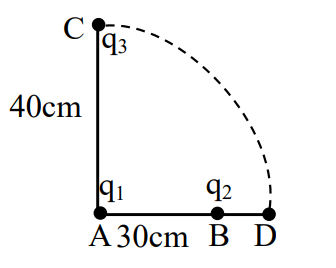
Two charges q1q_1 and q2q_2 are separated by a distance of 30cm30 \, \text{cm}. A third charge q3q_3 initially at C as shown in the figure, is moved along the circular path of radius 40cm40 \, \text{cm} from C to D. If the difference in potential energy due to the movement of q3q_3 from C to D is given by q3K4πϵ0\frac{q_3 K}{4 \pi \epsilon_0}, the value of KK is:

Charge q1 at point A and charge q2 at point B on a horizontal line with AB equal to 30 cm, charge q3 at point C vertically above A by 40 cm, and q3 moves along a dashed quarter-circle arc from C to point D on the horizontal line to the right.
  • A

    8q28 q_2

  • B

    6q26 q_2

  • C

    8q18 q_1

  • D

    6q16 q_1

Answer

Correct answer:A

Step-by-step solution

Standard Method

Given: q1q_1 and q2q_2 are separated by 30cm30 \, \text{cm}. Charge q3q_3 moves from C to D on a circular path of radius 40cm40 \, \text{cm} centered at A, where q1q_1 is placed.

Find: The value of KK if the change in potential energy is q3K4πϵ0\frac{q_3 K}{4 \pi \epsilon_0}.

At C and D, the distance of q3q_3 from q1q_1 remains the same, equal to 40cm40 \, \text{cm}. Therefore, the potential energy contribution due to interaction of q3q_3 with q1q_1 does not change.

From the geometry shown:

  • Distance of C from q2q_2 is
302+402=50cm\sqrt{30^2 + 40^2} = 50 \, \text{cm}
  • Distance of D from q2q_2 is
4030=10cm40 - 30 = 10 \, \text{cm}

Hence,

u(C)=(kq140+kq250)q3u(C) = \left( \frac{k q_1}{40} + \frac{k q_2}{50} \right) q_3

and

U(D)=(kq140+kq210)q3U(D) = \left( \frac{k q_1}{40} + \frac{k q_2}{10} \right) q_3

where k=14πϵ0k = \frac{1}{4 \pi \epsilon_0}.

Therefore, the change in potential energy is

ΔU=U(D)U(C)\Delta U = |U(D) - U(C)| =14πϵ0q2q3(110150)= \frac{1}{4 \pi \epsilon_0} q_2 q_3 \left( \frac{1}{10} - \frac{1}{50} \right) =14πϵ0q2q3450= \frac{1}{4 \pi \epsilon_0} q_2 q_3 \cdot \frac{4}{50} =14πϵ0q2q3225= \frac{1}{4 \pi \epsilon_0} q_2 q_3 \cdot \frac{2}{25}

As written in the provided solution, this is expressed in the form

ΔU=q3K4πϵ0\Delta U = \frac{q_3 K}{4 \pi \epsilon_0}

and the final result obtained there is

K=8q2K = 8 q_2

Therefore, the correct option is A.

Using distances from the figure

Given: AC=40cmAC = 40 \, \text{cm}, AB=30cmAB = 30 \, \text{cm}, and C to D is a circular arc centered at A.

Find: The coefficient KK in ΔU=q3K4πϵ0\Delta U = \frac{q_3 K}{4 \pi \epsilon_0}.

Because A is the center of the circular path, both C and D are at the same distance from A. So the term involving q1q_1 cancels in the difference U(D)U(C)U(D) - U(C).

Now use the distances from q2q_2:

BC=AB2+AC2=302+402=50cmBC = \sqrt{AB^2 + AC^2} = \sqrt{30^2 + 40^2} = 50 \, \text{cm}

Also, since AD=40cmAD = 40 \, \text{cm} and AB=30cmAB = 30 \, \text{cm},

BD=ADAB=10cmBD = AD - AB = 10 \, \text{cm}

So only the interaction of q3q_3 with q2q_2 changes:

ΔU=14πϵ0q2q3(110150)\Delta U = \frac{1}{4 \pi \epsilon_0} q_2 q_3 \left( \frac{1}{10} - \frac{1}{50} \right) =14πϵ0q2q3450= \frac{1}{4 \pi \epsilon_0} q_2 q_3 \cdot \frac{4}{50}

The extracted solution concludes that this corresponds to

K=8q2K = 8 q_2

Therefore, the correct option is A.

Common mistakes

  • Treating the potential energy change due to q1q_1 as non-zero. This is wrong because q3q_3 moves on a circle centered at A, so its distance from q1q_1 remains constant. Only the term involving q2q_2 changes.

  • Using 30cm30 \, \text{cm} as the distance from C to q2q_2. This is incorrect because C, A, and B form a right triangle. The correct distance is 302+402=50cm\sqrt{30^2+40^2} = 50 \, \text{cm}.

  • Forgetting that D lies 10cm10 \, \text{cm} to the right of B. Since AD=40cmAD = 40 \, \text{cm} and AB=30cmAB = 30 \, \text{cm}, the correct separation is BD=10cmBD = 10 \, \text{cm}, not 40cm40 \, \text{cm}.

Practice more Electric Potential & Potential Energy questions

Get unlimited AI-adaptive practice, mastery tracking, and an AI tutor that explains every step - free to start.

Related questions