MCQEasyJEE 2026Electric Potential & Potential Energy

JEE Physics 2026 Question with Solution

Five positive charges each having charge qq are placed at the vertices of a regular pentagon as shown in the figure. The electric potential VV and the electric field E\vec{E} at the center OO of the pentagon due to these five positive charges are
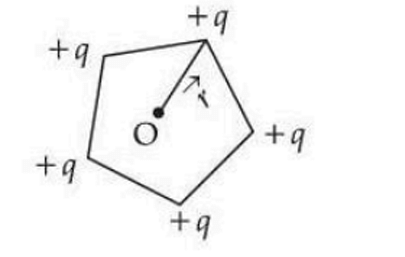
A regular pentagon with positive charges +q at all five vertices and center O marked inside, with distance r from center to one vertex indicated by an arrow.
  • A

    V=5q4πε0rV = \dfrac{5q}{4\pi\varepsilon_0 r} and E=53q8πε0r2r^\vec{E} = \dfrac{5\sqrt{3}q}{8\pi\varepsilon_0 r^2}\,\hat{r}

  • B

    V=0V = 0 and E=0\vec{E} = 0

  • C

    V=5q4πε0rV = \dfrac{5q}{4\pi\varepsilon_0 r} and E=5q4πε0r2r^\vec{E} = \dfrac{5q}{4\pi\varepsilon_0 r^2}\,\hat{r}

  • D

    V=5q4πε0rV = \dfrac{5q}{4\pi\varepsilon_0 r} and E=0\vec{E} = 0

Answer

Correct answer:D

Step-by-step solution

Standard Method

Given: Five identical positive charges of magnitude qq are placed at the vertices of a regular pentagon, each at distance rr from the center OO.

Find: The electric potential VV and electric field E\vec{E} at the center.

Step 1: Electric potential at the center

Electric potential is a scalar quantity, so the contributions add algebraically.

Potential due to one charge at the center is

V1=q4πε0rV_1 = \frac{q}{4\pi\varepsilon_0 r}

For five identical charges,

V=5V1=5q4πε0rV = 5V_1 = \frac{5q}{4\pi\varepsilon_0 r}

Step 2: Electric field at the center

Electric field is a vector quantity. The fields due to the five charges at the center have equal magnitude and are symmetrically distributed in direction.

By regular pentagonal symmetry, the vector sum cancels:

E=0\vec{E} = 0

Conclude: Therefore, the electric potential is 5q4πε0r\dfrac{5q}{4\pi\varepsilon_0 r} and the electric field is 00. The correct option is D.

Common mistakes

  • Adding electric field magnitudes directly and concluding a non-zero field. This is wrong because electric field is a vector and directions matter. Use symmetry and vector addition, which gives complete cancellation at the center.

  • Assuming the potential is also zero because the field is zero. This is wrong because electric potential is a scalar and adds algebraically. Here all five positive contributions add to a non-zero value.

  • Using the side length of the pentagon instead of the distance rr from the center to each charge. This is wrong because the potential and field at the center depend on the center-to-vertex distance. Use rr exactly as shown.

Practice more Electric Potential & Potential Energy questions

Get unlimited AI-adaptive practice, mastery tracking, and an AI tutor that explains every step — free to start.

Related questions