
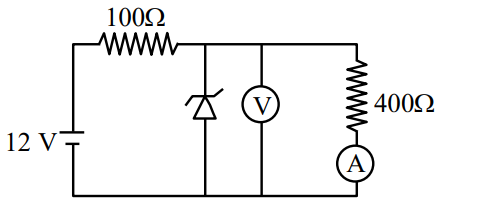
In the following circuit, the reading of the ammeter will be: (Take Zener breakdown voltage = )
- A
- B
- C
- D
In the following circuit, the reading of the ammeter will be: (Take Zener breakdown voltage = )
Correct answer:C
Standard Method
Given:
Find: The ammeter reading.
Since the applied voltage is greater than the Zener breakdown voltage, the Zener diode operates in breakdown and maintains a constant voltage of across itself. The Zener diode and the load resistor are in parallel, so the voltage across the load resistor is also
Using Ohm's law for the resistor,
The ammeter is in series with the load resistor, so it measures this current.
Therefore, the reading of the ammeter is . The correct option is C.
Voltage Check Before Breakdown Conclusion
Given:
Find: The current through the ammeter.
First, estimate the voltage across the branch containing the Zener diode and the resistor:
Since , the Zener diode goes into breakdown. Hence, the voltage across the resistor becomes fixed at .
Now apply Ohm's law:
Therefore, the ammeter reads . The correct option is C.
Assuming the full supply voltage appears across the resistor is incorrect because the Zener diode in breakdown clamps the parallel branch voltage to . Use the Zener voltage across the load, not the source voltage.
Ignoring that the Zener diode and the load resistor are in parallel leads to a wrong voltage assignment. Components in parallel have the same voltage, so the resistor must also have across it.
Using the series resistor to calculate the ammeter current is wrong because the ammeter measures the current through the load branch. Apply Ohm's law specifically to the load resistor.
Get unlimited AI-adaptive practice, mastery tracking, and an AI tutor that explains every step — free to start.