
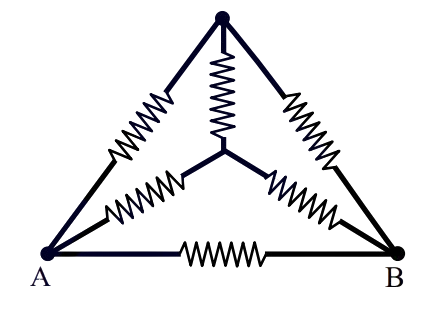
A wire of resistance is bent into a triangular pyramid as shown in the figure, with each segment having the same length. The resistance between points and is . The value of is:
- A
- B
- C
- D
A wire of resistance is bent into a triangular pyramid as shown in the figure, with each segment having the same length. The resistance between points and is . The value of is:
Correct answer:D
Standard Method
Given: A wire of total resistance is bent into a triangular pyramid with all segments of equal length, so each segment has resistance
Find: The equivalent resistance between and , written as .
By symmetry, the network forms a balanced Wheatstone-bridge type arrangement between and . Hence the branches can be reduced to three parallel paths: two paths of resistance each and one direct path of resistance .
So,
Therefore,
which gives
Substitution and Conclusion
Now substitute
into
Then,
Using Symmetry Directly
Because all six edges of the triangular pyramid are equal, each edge has resistance . Symmetry about the line joining and makes the bridge balanced, so no extra current analysis is needed for the middle balancing branch. The network reduces immediately to two branches of in parallel with one branch of , giving
Therefore, the correct option is D, so .
Assuming each segment has resistance . This is wrong because is the resistance of the entire wire, not one edge. Since the pyramid has six equal segments, each segment must be .
Ignoring symmetry and treating the network as an arbitrary resistor combination. This misses the balanced-bridge simplification. Use symmetry first to identify equal-potential points and reduce the circuit correctly.
Adding all visible paths directly in series. That is incorrect because the paths between and are alternative current routes, so they combine in parallel after the symmetry-based reduction.
Get unlimited AI-adaptive practice, mastery tracking, and an AI tutor that explains every step — free to start.