
The major product (A) formed in the following reaction sequence is
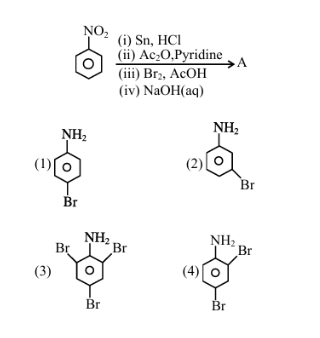

- A
4-aminobromobenzene
- B
p-bromoaniline
- C
2,4,6-tribromoaniline
- D
2,4-dibromoaniline
The major product (A) formed in the following reaction sequence is
4-aminobromobenzene
p-bromoaniline
2,4,6-tribromoaniline
2,4-dibromoaniline
Correct answer:B
Standard Method
Given: Nitrobenzene is subjected to the sequence .
Find: The major product A.
Step 1: Reduction of nitro group
Sn/HCl reduces the nitro group to an amino group . Thus nitrobenzene is converted to aniline.
Step 2: Acetylation of amino group
Acetic anhydride in pyridine converts aniline into acetanilide, that is, the amino group is protected as . This protection is necessary because a free amino group would strongly activate the ring and can lead to excessive bromination.
Step 3: Bromination
The amide group is an ortho/para directing group. Because it is bulky, bromination occurs predominantly at the para position in acetic acid.
Step 4: Hydrolysis
Treatment with aqueous NaOH hydrolyses the amide group back to the amino group. Therefore the final product is para-brominated aniline.
Therefore, the major product A is p-bromoaniline, so the correct option is B.
Reaction Sequence Explanation
The sequence involves reduction, protection, electrophilic substitution, and deprotection.
Nitrobenzene gives aniline.
Aniline gives acetanilide.
Bromination occurs mainly at the para position due to ortho/para directing nature and steric preference.
Hydrolysis removes the acetyl protecting group and gives p-bromoaniline. The solution states Correct Option: (2), which maps to B.
Assuming bromination occurs directly on aniline. This is wrong because free aniline is strongly activating and may lead to polybromination. First account for acetylation to acetanilide, then predict substitution.
Ignoring the directing effect of the protecting group. The group is ortho/para directing, so meta substitution is not favored. Use both directing effect and steric hindrance to identify the major product.
Forgetting the final hydrolysis step. This is wrong because the protected amide does not remain in the final product. After bromination, NaOH(aq) removes the acetyl group and regenerates .
Get unlimited AI-adaptive practice, mastery tracking, and an AI tutor that explains every step — free to start.