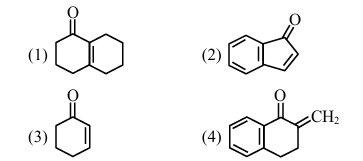
Aldol condensation is a popular and classical method to prepare α,β-unsaturated carbonyl compounds. This reaction can be both intermolecular and intramolecular. Predict which one of the following is not a product of intramolecular aldol condensation?
A
(1)
B
(2)
C
(3)
D
(4)
Answer
Correct answer:D
Step-by-step solution
Standard Method
Given: Four depicted α,β-unsaturated carbonyl compounds are to be checked for formation by intramolecular aldol condensation.
Find: Which structure is not a product of intramolecular aldol condensation.
The question asks: Among the four depicted α,β-unsaturated carbonyl compounds, which one cannot arise as the product of an intramolecular aldol condensation.
Concept used: Intramolecular aldol condensation occurs when a molecule containing two carbonyl groups forms an enolate at the α-position of one carbonyl, which then attacks the other carbonyl intramolecularly to close a ring. The favored ring sizes are 5-membered and 6-membered due to lower ring strain. After dehydration, the product is generally a conjugated enone with an endocyclic double bond.
1,5- or 1,6-dicarbonylintra-aldolbase\beta-hydroxycarbonyl−H2Oconjugated endocyclic enone
Thus, cyclic α,β-enones having the double bond inside the ring are typically formed, whereas exocyclic methylene enones are less favored as aldol dehydration products.
Step 1: Evaluate structure (1).
It is a fused bicyclic α,β-enone with the C=C inside the ring. Such a skeleton can arise from intramolecular aldol of suitably placed dicarbonyl compounds. Hence, (1) is feasible.
Step 2: Evaluate structure (2).
This is an indanone-type α,β-enone formed from an appropriate ortho-substituted aryl dicarbonyl system by intramolecular aldol followed by dehydration. Hence, (2) is feasible.
Step 3: Evaluate structure (3).
This is cyclohex-2-en-1-one, a classic intramolecular aldol product from a 1,6-dicarbonyl system after ring closure and dehydration. Hence, (3) is feasible.
Step 4: Evaluate structure (4).
This compound has an exocyclic methylene adjacent to the carbonyl. Formation of this exocyclic methylene enone through simple intramolecular aldol dehydration is disfavored because the more substituted endocyclic enone is thermodynamically more stable.
\beta-hydroxyketone−H2Omore substituted, more conjugatedendocyclic enone≫less substitutedexocyclic methylene enone
Therefore, the only structure that is not a typical product of intramolecular aldol condensation is (4). Hence, the correct option is D.
Common mistakes
Assuming any α,β-unsaturated carbonyl compound can form by intramolecular aldol condensation. This is wrong because the alkene position matters. Prefer the more stable endocyclic conjugated enone instead.
Ignoring ring-size preference. Intramolecular aldol reactions usually favor 5-membered or 6-membered ring formation. Checking ring feasibility helps eliminate unlikely products.
Choosing the exocyclic methylene product by focusing only on conjugation with C=O. This is incomplete because dehydration generally gives the more substituted thermodynamically stable alkene, which is usually endocyclic here.
Practice more Aldehydes & Ketones questions
Get unlimited AI-adaptive practice, mastery tracking, and an AI tutor that explains every step — free to start.