NVAMediumJEE 2025Faraday's Laws of EMI

JEE Physics 2025 Question with Solution

Conductor wire ABCDE with each arm 10cm10 \, \text{cm} in length is placed in magnetic field of 12Tesla\frac{1}{\sqrt{2}} \, \text{Tesla}, perpendicular to its plane. When conductor is pulled towards right with constant velocity of 10cm/s10 \, \text{cm}/\text{s}, induced emf between points A and E is _____ mV.
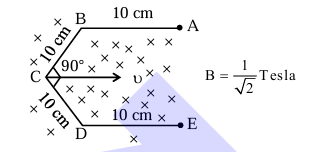
Bent conductor wire ABCDE with each arm 10 cm, moving right with velocity u in a uniform magnetic field B = 1/sqrt(2) Tesla directed into the plane.

Answer

Correct answer:10

Step-by-step solution

Standard Method

Given: A conductor frame ABCDE has each arm 10cm10 \, \text{cm}. It moves to the right with speed v=10cm s1=0.1m s1v = 10 \, \text{cm s}^{-1} = 0.1 \, \text{m s}^{-1} in a uniform magnetic field B=12TB = \dfrac{1}{\sqrt{2}} \, \text{T} perpendicular to the plane.

Find: The induced emf between A and E.

For a rigid conductor moving with uniform velocity v\vec v in a uniform magnetic field B\vec B perpendicular to the plane, the motional electric field is

Em=v×B\vec E_m = \vec v \times \vec B

Hence the emf between two points depends only on their displacement:

εAE=AE(v×B)d=(v×B)AE=BvΔy\varepsilon_{AE} = \int_A^E (\vec v \times \vec B) \cdot d\vec \ell = (\vec v \times \vec B) \cdot \vec{AE} = Bv \, \Delta y

where Δy\Delta y is the vertical separation between A and E.

Step 1: Find the vertical separation from the geometry.

Arms AB and DE are horizontal, so they give no vertical contribution. The two slanted arms are at 4545^\circ, so each contributes a vertical drop of

10cos45=102cm10 \cos 45^\circ = \frac{10}{\sqrt{2}} \, \text{cm}

Therefore,

Δy=102+102=202=102cm=0.12m\Delta y = \frac{10}{\sqrt{2}} + \frac{10}{\sqrt{2}} = \frac{20}{\sqrt{2}} = 10\sqrt{2} \, \text{cm} = 0.1\sqrt{2} \, \text{m}

Step 2: Use ε=BvΔy\varepsilon = Bv\Delta y.

ε=(12)(0.1)(0.12)=0.01V\varepsilon = \left(\frac{1}{\sqrt{2}}\right)(0.1)(0.1\sqrt{2}) = 0.01 \, \text{V}

Thus,

0.01V=10mV0.01 \, \text{V} = 10 \, \text{mV}

Therefore, the induced emf between A and E is 10mV10 \, \text{mV}.

Using vertical separation directly

Given: The conductor moves horizontally in a magnetic field perpendicular to the plane.

Find: The emf between A and E.

Since v\vec v is horizontal and B\vec B is perpendicular to the plane, v×B\vec v \times \vec B is vertical. Therefore only the vertical separation between A and E matters.

Directly,

ε=Bv×[2(10sin45 cm)]\varepsilon = Bv \times \left[2(10 \sin 45^\circ \text{ cm})\right]

Converting to SI,

ε=12×0.1×0.12=0.01V\varepsilon = \frac{1}{\sqrt{2}} \times 0.1 \times 0.1\sqrt{2} = 0.01 \, \text{V}

Therefore, the correct numerical answer is 10.

Common mistakes

  • Using the total wire length 50cm50 \, \text{cm} in the emf formula is incorrect because the emf depends on the displacement between A and E, not the entire path length. Use only the vertical separation Δy\Delta y.

  • Taking the horizontal segments AB and DE to contribute to emf is incorrect because v×B\vec v \times \vec B is vertical. Horizontal displacement gives zero dot product, so only vertical separation matters.

  • Forgetting unit conversion leads to a wrong magnitude. Convert 10cm/s10 \, \text{cm/s} to 0.1m/s0.1 \, \text{m/s} and 102cm10\sqrt{2} \, \text{cm} to 0.12m0.1\sqrt{2} \, \text{m} before substitution.

Practice more Faraday's Laws of EMI questions

Get unlimited AI-adaptive practice, mastery tracking, and an AI tutor that explains every step — free to start.

Related questions