
A perfect gas () having (independent of temperature) undergoes the above transformation from point to point . If each step is reversible, the total work done () while going from point to point is (\hspace{3cm) J (nearest integer) [Given : ]
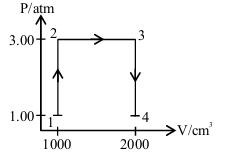
A perfect gas () having (independent of temperature) undergoes the above transformation from point to point . If each step is reversible, the total work done () while going from point to point is (\hspace{3cm) J (nearest integer) [Given : ]
Correct answer:304
Standard Method
Given: The gas goes from point to point through three reversible steps on the - diagram.
Find: Total work done from point to point .
For a reversible process,
So the total work is
For the isochoric steps, , so the work done is zero.
For the isobaric step ,
Here,
Thus,
Now add the contributions:
Convert to joules using
So,
Rounding to the nearest integer,
The blank asks for the numerical value, so the required answer is .
Step-by-step Work Analysis
Given: Only the horizontal segment of the path changes volume. Vertical segments have constant volume.
Find: Numerical value of the total work done.
Hence,
Therefore,
Using the conversion,
So the magnitude to be filled is . The final answer is .
Treating the vertical segments and as if they do work. This is wrong because in an isochoric process , so . Only segments with volume change contribute to work.
Using the wrong sign convention for chemistry. For expansion, chemistry uses , so the work here is negative. If the question asks for the number to fill in the blank, use the required numerical value after interpreting the sign from the statement.
Forgetting to convert into before using units. Pressure is given in atm, so the volume change must be in liters to compute work correctly.
Get unlimited AI-adaptive practice, mastery tracking, and an AI tutor that explains every step — free to start.