
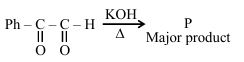
The major product in the following reaction is :
- A
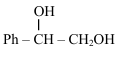
- B
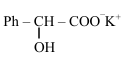
- C
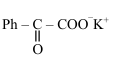
- D
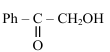
The major product in the following reaction is :
Correct answer:B
Standard Method
Given: The substrate is and it is treated with under heat.
Find: The major product formed in this reaction.
This is identified as a Cannizzaro reaction of an aldehyde lacking -hydrogen. In , the aldehyde group is more reactive toward base than the ketone group.
The key transformation is disproportionation of the aldehyde functionality in strong base. The aldehyde part is converted into a carboxylate, while reduction gives the adjacent carbon as an alcohol-bearing center.
Therefore, the major product is .
So, the correct option is B.
Explanation from the Extracted Solution
Given: The compound is an -keto aldehyde, , and the reagent is with heat.
Find: The major product after reaction.
The extracted solution states that this reaction proceeds through a Cannizzaro-type pathway because the aldehyde lacks -hydrogen.
The solution explicitly concludes: Therefore, the major product (P) is .
There is unrelated material in one extracted approach discussing ether cleavage with , but the relevant chemistry for this question is the second approach, which matches the given substrate and reagents. Hence the answer is determined from the matching solution.
Therefore, the correct option is B.
Mistake: Treating the reaction as an ordinary reduction or oxidation of only one carbonyl group. Why it is wrong: In strong base, this substrate undergoes a Cannizzaro-type disproportionation pathway. What to do instead: First check whether the aldehyde has an -hydrogen; if not, test for Cannizzaro behavior.
Mistake: Assuming the ketone carbonyl reacts preferentially over the aldehyde carbonyl. Why it is wrong: The aldehyde group is generally more reactive toward nucleophilic attack by than the ketone group. What to do instead: Identify the aldehyde center as the primary reactive site in base.
Mistake: Choosing the carboxylate-only product without the adjacent alcohol functionality. Why it is wrong: The mechanism involves hydride transfer and gives an -hydroxy carboxylate as the major product. What to do instead: Track both oxidation and reduction changes during the Cannizzaro process.
Get unlimited AI-adaptive practice, mastery tracking, and an AI tutor that explains every step — free to start.