MCQMediumJEE 2025Elastic & Inelastic Collisions

JEE Physics 2025 Question with Solution

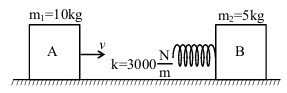
Two blocks A and B on a frictionless horizontal table, with A of 10 kg moving right at 3 m/s toward B of 5 kg, and a spring of constant 3000 N/m attached between them.

Consider two blocks A and B of masses m1=10m_1 = 10 kg and m2=5m_2 = 5 kg that are placed on a frictionless table. The block A moves with a constant speed v=3v = 3 m/s towards the block B kept at rest. A spring with spring constant k=3000k = 3000 N/m is attached with the block B as shown in the figure. After the collision, suppose that the blocks A and B, along with the spring in constant compression state, move together, then the compression in the spring is, (Neglect the mass of the spring)

  • A

    0.2 m

  • B

    0.4 m

  • C

    0.1 m

  • D

    0.3 m

Answer

Correct answer:C

Step-by-step solution

Standard Method

Given: m1=10kgm_1 = 10 \, \text{kg}, m2=5kgm_2 = 5 \, \text{kg}, initial velocity of block AA is v1=3m/sv_1 = 3 \, \text{m/s}, initial velocity of block BB is v2=0m/sv_2 = 0 \, \text{m/s}, and spring constant k=3000N/mk = 3000 \, \text{N/m}.

Find: The compression xx in the spring when both blocks move together with the spring in compressed state.

Using conservation of linear momentum:

m1v1+m2v2=(m1+m2)vcmm_1 v_1 + m_2 v_2 = (m_1 + m_2)v_{cm} (10kg)(3m/s)+(5kg)(0m/s)=(10kg+5kg)vcm(10 \, \text{kg})(3 \, \text{m/s}) + (5 \, \text{kg})(0 \, \text{m/s}) = (10 \, \text{kg} + 5 \, \text{kg})v_{cm} 30kg m/s=15kgvcm30 \, \text{kg m/s} = 15 \, \text{kg} \cdot v_{cm} vcm=3015=2m/sv_{cm} = \frac{30}{15} = 2 \, \text{m/s}

The kinetic energy lost during the inelastic collision is stored as spring potential energy.

Initial kinetic energy:

KEi=12m1v12=12(10kg)(3m/s)2=45JKE_i = \frac{1}{2}m_1 v_1^2 = \frac{1}{2}(10 \, \text{kg})(3 \, \text{m/s})^2 = 45 \, \text{J}

Final kinetic energy:

KEf=12(m1+m2)vcm2=12(15kg)(2m/s)2=30JKE_f = \frac{1}{2}(m_1 + m_2)v_{cm}^2 = \frac{1}{2}(15 \, \text{kg})(2 \, \text{m/s})^2 = 30 \, \text{J}

So, energy stored in the spring is:

PEspring=KEiKEf=45J30J=15JPE_{\text{spring}} = KE_i - KE_f = 45 \, \text{J} - 30 \, \text{J} = 15 \, \text{J}

Now,

PEspring=12kx2PE_{\text{spring}} = \frac{1}{2}kx^2 15=12(3000)x215 = \frac{1}{2}(3000)x^2 15=1500x215 = 1500x^2 x2=151500=1100x^2 = \frac{15}{1500} = \frac{1}{100} x=1100=110m=0.1mx = \sqrt{\frac{1}{100}} = \frac{1}{10} \, \text{m} = 0.1 \, \text{m}

Therefore, the compression in the spring is 0.1m0.1 \, \text{m}. The correct option is C.

Energy-Loss Interpretation

Given: Block AA of mass 10kg10 \, \text{kg} moves with speed 3m/s3 \, \text{m/s} toward block BB of mass 5kg5 \, \text{kg} at rest. The spring constant is 3000N/m3000 \, \text{N/m}.

Find: Spring compression xx.

First compute the common velocity after collision from momentum conservation:

pinitial=m1v=10kg3m/s=30kg m/sp_{\text{initial}} = m_1 \cdot v = 10 \, \text{kg} \cdot 3 \, \text{m/s} = 30 \, \text{kg m/s} pfinal=(m1+m2)vf=(10+5)kgvf=15kgvfp_{\text{final}} = (m_1 + m_2)v_f = (10 + 5) \, \text{kg} \cdot v_f = 15 \, \text{kg} \cdot v_f 30=15vfvf=2m/s30 = 15v_f \Rightarrow v_f = 2 \, \text{m/s}

Now compare kinetic energies.

Initial kinetic energy:

KEinitial=12m1v2=121032=45JKE_{\text{initial}} = \frac{1}{2}m_1 v^2 = \frac{1}{2} \cdot 10 \cdot 3^2 = 45 \, \text{J}

Final kinetic energy:

KEfinal=12(m1+m2)vf2=121522=30JKE_{\text{final}} = \frac{1}{2}(m_1 + m_2)v_f^2 = \frac{1}{2} \cdot 15 \cdot 2^2 = 30 \, \text{J}

Hence the energy stored in the spring is:

PEspring=KEinitialKEfinal=4530=15J\text{PE}_{\text{spring}} = KE_{\text{initial}} - KE_{\text{final}} = 45 - 30 = 15 \, \text{J}

For the spring,

12kx2=15\frac{1}{2}kx^2 = 15 123000x2=15\frac{1}{2} \cdot 3000 \cdot x^2 = 15 1500x2=15x2=0.011500x^2 = 15 \Rightarrow x^2 = 0.01 x=0.01=0.1mx = \sqrt{0.01} = 0.1 \, \text{m}

Therefore, the spring compression is 0.1m0.1 \, \text{m}.

Common mistakes

  • Using conservation of kinetic energy for the collision is incorrect because the blocks move together, so the collision is inelastic. Use conservation of momentum first, then relate the lost kinetic energy to spring potential energy.

  • Equating the entire initial kinetic energy to spring potential energy is wrong because after collision the combined blocks still move with a common velocity. Subtract the final kinetic energy of the combined mass before calculating spring compression.

  • Using only one block's mass in the final kinetic energy is incorrect because both blocks move together after collision. The final kinetic energy must be calculated with mass m1+m2m_1 + m_2.

Practice more Elastic & Inelastic Collisions questions

Get unlimited AI-adaptive practice, mastery tracking, and an AI tutor that explains every step — free to start.

Related questions