
Which compound would give 3-methyl-6-oxoheptanal upon ozonolysis ?
- A

- B

- C

- D

Which compound would give 3-methyl-6-oxoheptanal upon ozonolysis ?
Correct answer:B
Standard Method
Given: We need the compound that gives 3-methyl-6-oxoheptanal on ozonolysis.
Find: The correct precursor alkene.
Ozonolysis of alkenes cleaves the carbon-carbon double bond and converts the two alkene carbons into carbonyl groups. Therefore, we identify the alkene whose cleavage gives the required aldehyde-ketone product.
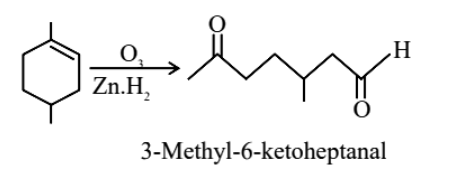
From the provided solution, the structure that matches the required cleavage pattern is Option B. The solution explicitly states that ozonolysis of Option B forms the required product 3-methyl-6-ketoheptanal, corresponding to 3-methyl-6-oxoheptanal.
Therefore, the correct option is B.
Detailed Elimination of Options
Given: Ozonolysis cleaves an alkene into carbonyl compounds.
Find: Which option gives 3-methyl-6-oxoheptanal.
The extracted solution explains the selection by checking the ozonolysis products of each option:
Hence, the precursor alkene is Option B.
Assuming ozonolysis removes the double bond without cleaving the molecule. This is wrong because ozonolysis breaks the bond into carbonyl groups. Always split the alkene at the double bond first.
Ignoring whether each alkene carbon becomes an aldehyde or a ketone. This is wrong because substitution on the double-bond carbon determines the carbonyl product. Check hydrogen substitution carefully before choosing the option.
Matching only the carbon count and not the position of the methyl group. This is wrong because the product is specifically 3-methyl-6-oxoheptanal. Track the substituent positions after cleavage, not just the total number of carbons.
Get unlimited AI-adaptive practice, mastery tracking, and an AI tutor that explains every step — free to start.