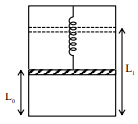
A piston of mass is hung from a massless spring whose restoring force law goes as , where is the spring constant of appropriate dimension. The piston separates the vertical chamber into two parts, where the bottom part is filled with moles of an ideal gas. An external work is done on the gas isothermally (at a constant temperature ) with the help of a heating filament (with negligible volume) mounted in lower part of the chamber, so that the piston goes up from a height to , the total energy delivered by the filament is (Assume spring to be in its natural length before heating)
- A
- B
- C
- D
