MCQMediumJEE 2025Equation of Line in 3D

JEE Mathematics 2025 Question with Solution

Let a line passing through the point (4,1,0)(4,1,0) intersect the line L1:x12=y23=z34L_1: \frac{x - 1}{2} = \frac{y - 2}{3} = \frac{z - 3}{4} at the point A(α,β,γ)A(\alpha, \beta, \gamma) and the line L2:x6=y=z+4L_2: x - 6 = y = -z + 4 at the point B(a,b,c)B(a, b, c). Then 101αβγabc\begin{vmatrix} 1 & 0 & 1\\ \alpha & \beta & \gamma \\ a & b & c \end{vmatrix} is equal to

  • A

    88

  • B

    1616

  • C

    1212

  • D

    66

Answer

Correct answer:A

Step-by-step solution

Standard Method

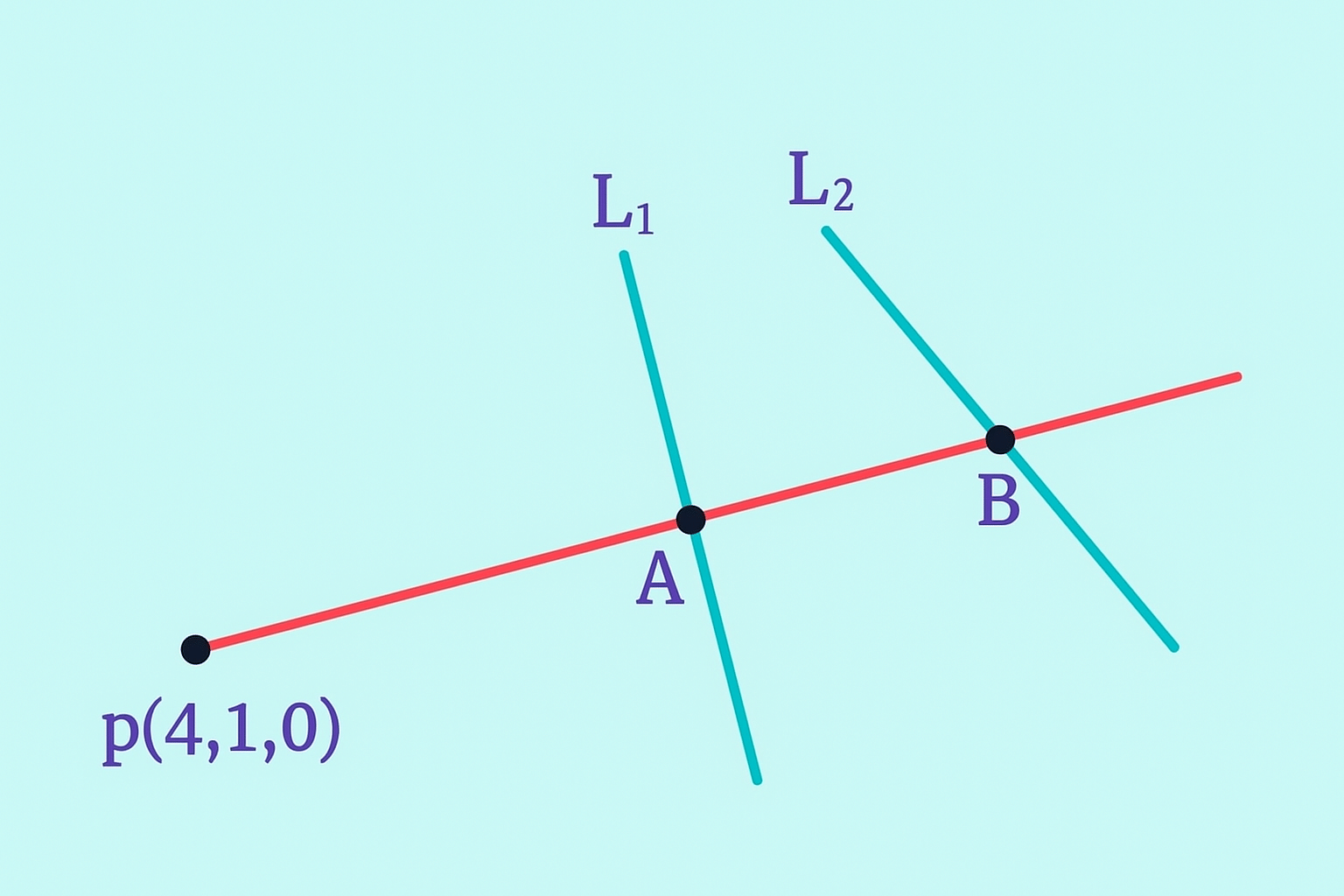
Given: A line passes through P(4,1,0)P(4,1,0) and intersects L1L_1 at A(α,β,γ)A(\alpha,\beta,\gamma) and L2L_2 at B(a,b,c)B(a,b,c).

Find: The value of

101αβγabc\begin{vmatrix} 1 & 0 & 1 \\ \alpha & \beta & \gamma \\ a & b & c \end{vmatrix}
A schematic figure showing point P(4,1,0) on a red line intersecting two blue lines labeled L1 and L2 at points A and B respectively.

Let the point AA on L1L_1 be represented by parameter pp:

x12=y23=z34=p\frac{x - 1}{2} = \frac{y - 2}{3} = \frac{z - 3}{4} = p

So,

A(2p+1,3p+2,4p+3)A(2p + 1, 3p + 2, 4p + 3)

Let the point BB on L2L_2 be represented by parameter qq:

x6=y=z+4=qx - 6 = y = -z + 4 = q

So,

B(q+6,q,4q)B(q + 6, q, 4 - q)

Now the direction ratios of PA\overrightarrow{PA} and PB\overrightarrow{PB} are:

PA=(2p3,3p+1,4p+3)\overrightarrow{PA} = (2p - 3, 3p + 1, 4p + 3) PB=(q+2,q1,4q)\overrightarrow{PB} = (q + 2, q - 1, 4 - q)

Since P,A,BP, A, B are collinear, these vectors are proportional:

2p3q+2=3p+1q1=4p+34q\frac{2p - 3}{q + 2} = \frac{3p + 1}{q - 1} = \frac{4p + 3}{4 - q}

Equating pairwise and solving, the solution gives:

pq+8p+4q1=0pq + 8p + 4q - 1 = 0 7pq16p+4q7=07pq - 16p + 4q - 7 = 0

Hence,

pq=3,p=1,q=3pq = -3, \quad p = -1, \quad q = 3

Therefore,

A(1,1,1),B(9,3,1)A(-1,-1,-1), \quad B(9,3,1)

Now compute the determinant:

101111931\begin{vmatrix} 1 & 0 & 1 \\ -1 & -1 & -1 \\ 9 & 3 & 1 \end{vmatrix}

Expanding along the first row,

=111310+11193= 1 \cdot \begin{vmatrix} -1 & -1 \\ 3 & 1 \end{vmatrix} - 0 + 1 \cdot \begin{vmatrix} -1 & -1 \\ 9 & 3 \end{vmatrix} =1((1)(1)(1)(3))+1((1)(3)(1)(9))= 1((-1)(1) - (-1)(3)) + 1((-1)(3) - (-1)(9)) =(1+3)+(3+9)= ( -1 + 3 ) + ( -3 + 9 ) =2+6=8= 2 + 6 = 8

Therefore, the determinant is 88 and the correct option is A.

Common mistakes

  • Students often parametrize L2L_2 incorrectly. From x6=y=z+4=qx - 6 = y = -z + 4 = q, the correct coordinates are B(q+6,q,4q)B(q+6, q, 4-q), not B(q+6,q,q4)B(q+6, q, q-4). Write each coordinate separately from the common parameter.

  • A common mistake is to use the direction ratios of the given lines L1L_1 and L2L_2 directly. The required collinearity is for PA\overrightarrow{PA} and PB\overrightarrow{PB}, because P,A,BP, A, B lie on the same line.

  • While expanding the determinant, sign errors are frequent. In cofactor expansion along the first row, keep track of minors carefully and evaluate each 2×22 \times 2 determinant before adding the terms.

Practice more Equation of Line in 3D questions

Get unlimited AI-adaptive practice, mastery tracking, and an AI tutor that explains every step — free to start.

Related questions