
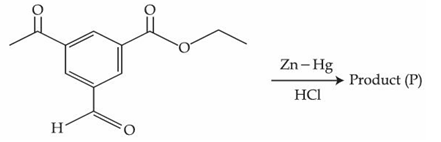
The product (P) formed in the following reaction is:
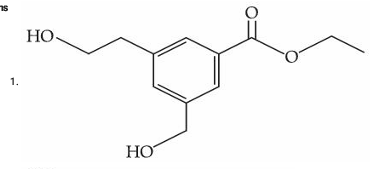
- A
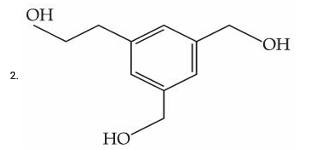
- B
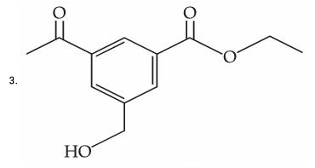
- C
- D
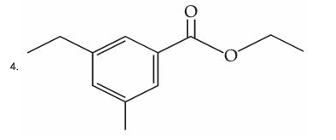
The product (P) formed in the following reaction is:
Correct answer:B
Standard Method
Given: The substrate is treated with and .
Find: The correct product (P) formed in this reaction.
Clemmensen reduction converts aldehydes and ketones into the corresponding hydrocarbon groups under strongly acidic conditions, while the ester group remains unchanged.
From the given structure:
So we must select the option in which the ketone becomes an alkyl side chain, the aldehyde becomes a methyl group, and the ester remains as an ester.
The solution states that Option (2) correctly matches this transformation.
Therefore, the correct option is B.
Functional Group Analysis
Given: A compound containing ketone, aldehyde, and ester groups is subjected to Clemmensen reduction.
Find: Which option represents the product.
Identify principle: Clemmensen reduction selectively reduces carbonyl groups of aldehydes and ketones in acidic medium.
Apply reaction rule:
The ester group remains unchanged under these conditions.
Evaluate options:
Therefore, the correct option is B.
Mistake: Treating Clemmensen reduction as if it forms alcohols from carbonyl compounds. Why wrong: reduces aldehydes and ketones all the way to hydrocarbons, not alcohols. Do instead: replace the aldehyde by and the ketone carbonyl by .
Mistake: Assuming the ester group is also reduced. Why wrong: under standard Clemmensen conditions, the ester remains unchanged while aldehydes and ketones are reduced. Do instead: keep the ester functionality intact when choosing the product.
Mistake: Choosing the option by counting oxygen atoms without checking functional group identity. Why wrong: different oxygen-containing groups behave differently in this reaction. Do instead: inspect each carbonyl group separately and apply reaction selectivity.
Get unlimited AI-adaptive practice, mastery tracking, and an AI tutor that explains every step — free to start.