MCQEasyJEE 2025Internal Energy & Enthalpy

JEE Chemistry 2025 Question with Solution

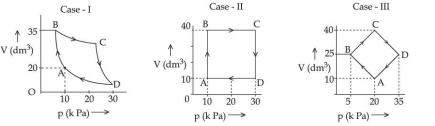
An ideal gas undergoes a cyclic transformation starting from point A and coming back to the same point by tracing the path A→B→C→D→A as shown in the three cases below. Choose the correct option regarding ΔU\Delta U:

Three PV diagrams labeled Case-I, Case-II and Case-III showing cyclic paths A to B to C to D to A with pressure and volume scales marked.
  • A

    ΔU(Case-III)>ΔU(Case-II)>ΔU(Case-I)\Delta U(\text{Case-III}) > \Delta U(\text{Case-II}) > \Delta U(\text{Case-I})

  • B

    ΔU(Case-I)=ΔU(Case-II)=ΔU(Case-III)\Delta U(\text{Case-I}) = \Delta U(\text{Case-II}) = \Delta U(\text{Case-III})

  • C

    ΔU(Case-I)>ΔU(Case-II)>ΔU(Case-III)\Delta U(\text{Case-I}) > \Delta U(\text{Case-II}) > \Delta U(\text{Case-III})

  • D

    ΔU(Case-I)>ΔU(Case-III)>ΔU(Case-II)\Delta U(\text{Case-I}) > \Delta U(\text{Case-III}) > \Delta U(\text{Case-II})

Answer

Correct answer:B

Step-by-step solution

State Function in a Cyclic Process

Given: An ideal gas undergoes a cyclic transformation in each of the three cases and returns to the initial point A.

Find: The correct relation among ΔU\Delta U for Case-I, Case-II, and Case-III.

For an ideal gas, internal energy depends only on the thermodynamic state, so it is a state function. In a cyclic process, the system returns to its initial state. Therefore, the initial and final states are the same.

Using the first law of thermodynamics,

ΔU=QW\Delta U = Q - W

but for a complete cycle, since the state returns to the starting point,

ΔUcycle=0\Delta U_{\text{cycle}} = 0

Hence, in all three cases,

ΔU(Case-I)=ΔU(Case-II)=ΔU(Case-III)=0\Delta U(\text{Case-I}) = \Delta U(\text{Case-II}) = \Delta U(\text{Case-III}) = 0

Therefore, the correct option is B.

Why Path Does Not Matter

Given: Three different cyclic paths A→B→C→D→A are shown on the PVPV diagram.

Find: Whether ΔU\Delta U differs from one case to another.

Concept used: For an ideal gas, internal energy depends only on temperature. Since temperature is determined by the state of the system, internal energy is a state function.

In a cyclic process, the gas starts from a point and returns to the same point after completing the cycle. So the initial and final temperatures are equal.

Therefore,

ΔUcycle=0\Delta U_{\text{cycle}} = 0

for each case separately.

Thus,

ΔU(Case-I)=0,ΔU(Case-II)=0,ΔU(Case-III)=0\Delta U(\text{Case-I}) = 0, \quad \Delta U(\text{Case-II}) = 0, \quad \Delta U(\text{Case-III}) = 0

So,

ΔU(Case-I)=ΔU(Case-II)=ΔU(Case-III)\Delta U(\text{Case-I}) = \Delta U(\text{Case-II}) = \Delta U(\text{Case-III})

Therefore, all three are equal and the correct option is B.

Common mistakes

  • Assuming ΔU\Delta U depends on the shape of the path on the PVPV diagram. This is wrong because internal energy is a state function. Use only the initial and final states to evaluate ΔU\Delta U.

  • Confusing net work done in a cycle with change in internal energy. Work done can be non-zero for a cyclic process, but ΔU=0\Delta U = 0 because the system returns to the same state.

  • Using ΔU=QW\Delta U = Q - W and concluding that different values of QQ or WW must give different ΔU\Delta U. This is incorrect because in a cycle, QQ and WW may both vary with path, yet their net difference over the full cycle is zero.

Practice more Internal Energy & Enthalpy questions

Get unlimited AI-adaptive practice, mastery tracking, and an AI tutor that explains every step — free to start.

Related questions