MCQMediumJEE 2025Electric Potential & Potential Energy
JEE Physics 2025 Question with Solution
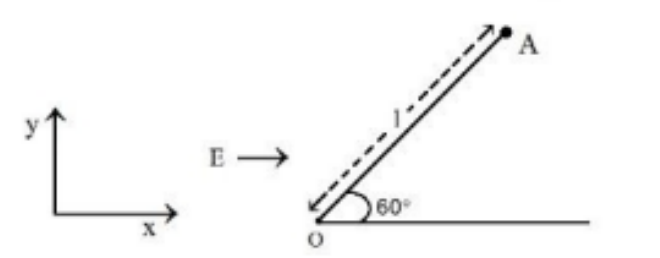
A particle of mass m and charge q is fastened to one end A of a massless string having equilibrium length l, whose other end is fixed at point O. The whole system is placed on a frictionless horizontal plane and is initially at rest. If a uniform electric field is switched on along the direction as shown in the figure, then the speed of the particle when it crosses the x-axis is:
A
mqEl
B
m2qEl
C
4mqEl
D
2mqEl
Answer
Correct answer:B
Step-by-step solution
Work-Energy Method
Given: A particle of mass m and charge q is attached to a massless string of length l on a frictionless horizontal plane. A uniform electric field E acts along the positive x-direction.
Find: The speed of the particle when it crosses the x-axis.
The solution uses the work-energy principle.
The electric force on the particle is
Felectric=qE
When the particle crosses the x-axis, the displacement along the field direction is taken as l in the provided solution.
Hence, the work done by the electric field is
W=qEl
This work appears as kinetic energy:
21mv2=qEl
Solving for v,
v=m2qEl
Therefore, the speed of the particle is m2qEl, so the correct option is B.
Common mistakes
Using the tension in the string to calculate work. Tension does no work here because it is always along the string, while the instantaneous displacement is perpendicular to it. Use only the work done by the electric force in the energy equation.
Substituting the wrong displacement in the work term. In a uniform electric field, work depends on displacement along the field direction, not on the curved path length. Use displacement along the x-direction while applying W=qEΔx.
Confusing force with potential energy change directly without writing the work-energy relation. First compute the work done by the electric field, then equate it to the change in kinetic energy.
Practice more Electric Potential & Potential Energy questions
Get unlimited AI-adaptive practice, mastery tracking, and an AI tutor that explains every step — free to start.