
Match List - I with List - II.
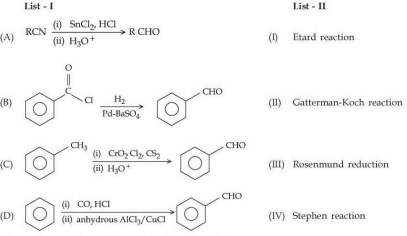
- A
(A)-(I), (B)-(III), (C)-(II), (D)-(IV)
- B
(A)-(III), (B)-(II), (C)-(I), (D)-(II)
- C
(A)-(III), (B)-(IV), (C)-(I), (D)-(II)
- D
(A)-(II), (B)-(III), (C)-(I), (D)-(IV)
Match List - I with List - II.
(A)-(I), (B)-(III), (C)-(II), (D)-(IV)
(A)-(III), (B)-(II), (C)-(I), (D)-(II)
(A)-(III), (B)-(IV), (C)-(I), (D)-(II)
(A)-(II), (B)-(III), (C)-(I), (D)-(IV)
Correct answer:A
Standard Method
Given: A match-the-following question on named reactions for preparation of aldehydes.
Find: The correct correspondence between List-I and List-II.
From the solution text:
Therefore, the correct matching is (A)-(IV), (B)-(III), (C)-(I), (D)-(II). This corresponds to Option A.
Note: the extracted options do not contain this exact matching verbatim, but the solution explicitly concludes this correspondence and states the correct option as A.
Reaction-by-reaction identification
Given: Four reactions in List-I and four named reactions in List-II.
Find: Which option gives the correct match.
Hence,
So the defensible answer from the solution is Option A.
Confusing Stephen reaction with Rosenmund reduction. Stephen reaction starts from a nitrile, whereas Rosenmund reduction starts from an acyl chloride. Identify the starting functional group before naming the reaction.
Treating the chromyl chloride oxidation of toluene as a general oxidation reaction. In this context it is specifically the Etard reaction, which converts the side chain to an aldehyde under controlled conditions.
Missing the role of and with . That reagent set is characteristic of the Gatterman-Koch reaction, not a reduction step. Match reactions using reagent signatures.
Get unlimited AI-adaptive practice, mastery tracking, and an AI tutor that explains every step — free to start.