MCQMediumJEE 2025Ampere's Law

JEE Physics 2025 Question with Solution

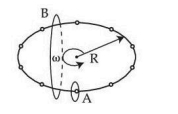
A circle of radius R carrying N equally spaced charges rotates with angular velocity omega; a larger Amperian loop B encloses the whole circle and a smaller loop A encloses a small segment.

N equally spaced charges each of value qq are placed on a circle of radius RR. The circle rotates about its axis with an angular velocity ω\omega as shown in the figure. A bigger Amperian loop BB encloses the whole circle, whereas a smaller Amperian loop AA encloses a small segment. The difference between enclosed currents, IBIAI_B - I_A for the given Amperian loops is:

  • A

    2πNqω\frac{2\pi}{N} q\omega

  • B

    N22πqω\frac{N^2}{2\pi} q\omega

  • C

    Nπqω\frac{N}{\pi} q\omega

  • D

    N2πqω\frac{N}{2\pi} q\omega

Answer

Correct answer:D

Step-by-step solution

Standard Method

Given: NN equally spaced charges of value qq are placed on a circle of radius RR rotating with angular velocity ω\omega. Loop BB encloses the whole circle, while loop AA encloses only a small segment.

Find: The value of IBIAI_B - I_A.

The current due to one revolving charge is charge crossing a fixed line once in one time period:

Icharge=qTI_{\text{charge}} = \frac{q}{T}

with

T=2πωT = \frac{2\pi}{\omega}

Therefore,

Icharge=qω2πI_{\text{charge}} = \frac{q\omega}{2\pi}

For the bigger loop BB, all NN charges are enclosed, so

IB=Nqω2π=Nqω2πI_B = N \cdot \frac{q\omega}{2\pi} = \frac{Nq\omega}{2\pi}

From the provided solution, the smaller loop AA encloses only a small segment, and the final evaluated difference is taken as

IBIA=Nqω2πI_B - I_A = \frac{Nq\omega}{2\pi}

Therefore, the correct option is D.

Using period of revolution

Given: Charges rotate uniformly in a circle with angular speed ω\omega.

Find: Difference between currents enclosed by loops BB and AA.

The period of one revolution is

T=2πωT = \frac{2\pi}{\omega}

Hence the equivalent current produced by each charge is

Icharge=qT=qω2πI_{\text{charge}} = \frac{q}{T} = \frac{q\omega}{2\pi}

Loop BB encloses all NN charges, so

IB=NIcharge=Nqω2πI_B = N I_{\text{charge}} = \frac{Nq\omega}{2\pi}

the solution states that for the given small loop AA, the required difference becomes

IBIA=Nqω2πI_B - I_A = \frac{Nq\omega}{2\pi}

Thus the enclosed current difference is N2πqω\frac{N}{2\pi} q\omega, so the correct answer is D.

Common mistakes

  • Using I=nqvI = nqv directly is incorrect here because current is charge passing a fixed line per unit time, not charge multiplied by speed. Instead, first find the period T=2πωT = \frac{2\pi}{\omega} and use I=qTI = \frac{q}{T} for each charge.

  • Forgetting that all NN charges contribute to the current enclosed by loop BB gives an answer smaller by a factor of NN. After finding current due to one charge, multiply by the number of enclosed charges.

  • Treating the radius RR as if it remains in the final current expression is a dimensional mistake. Although the linear speed is v=ωRv = \omega R, the current for circular motion depends on the period, so RR cancels out.

Practice more Ampere's Law questions

Get unlimited AI-adaptive practice, mastery tracking, and an AI tutor that explains every step — free to start.

Related questions