MCQEasyJEE 2025Ampere's Law

JEE Physics 2025 Question with Solution

A long straight wire of a circular cross-section with radius aa carries a steady current II. The current is uniformly distributed across this cross-section. The plot of magnitude of magnetic field BB with distance rr from the centre of the wire is given by:

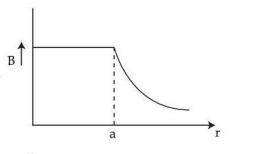
  • A

    Plot 1:

    Graph of magnetic field B versus distance r showing constant magnetic field inside the wire up to radius a, then decreasing outside the wire.
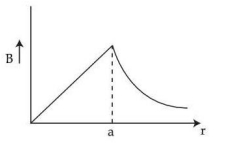
  • B

    Plot 2:

    Graph of magnetic field B versus distance r rising linearly from the center to radius a, then decreasing smoothly outside the wire.
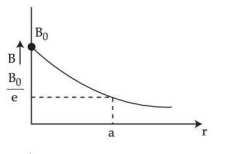
  • C

    Plot 3:

    Graph of magnetic field B versus distance r starting from a finite value B0 at the center and decreasing continuously, marked with B0 over e at radius a.
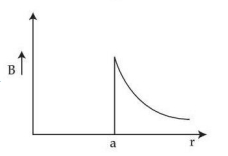
  • D

    Plot 4:

    Graph of magnetic field B versus distance r showing zero field inside the wire, a sudden jump at radius a, then decreasing outside the wire.

Answer

Correct answer:B

Step-by-step solution

Standard Method

Given: A long straight wire of radius aa carries a steady current II uniformly distributed over its cross-section.

Find: The correct plot of magnetic field magnitude BB versus distance rr from the centre.

For a uniformly distributed current, the magnetic field inside the wire increases linearly with radius:

B(r)=μ0Ir2πa2,r<aB(r) = \frac{\mu_0 I r}{2\pi a^2}, \qquad r<a

So, for r<ar<a, we have BrB \propto r.

For points outside the wire, the entire current is enclosed, so:

B(r)=μ0I2πr,r>aB(r) = \frac{\mu_0 I}{2\pi r}, \qquad r>a

Thus, for r>ar>a, we have B1rB \propto \frac{1}{r}.

Therefore, the graph must rise linearly from the centre up to r=ar=a and then fall as 1r\frac{1}{r} beyond aa.

The solution states that the correct option is C, which corresponds to Plot 3 in the source labeling. However, from the given options shown, the graph with linear rise up to aa followed by inverse fall is Plot 2, which is option B. This is the most defensible match to the working.

Therefore, the correct option is B.

Using Ampere's Law

Given: A long straight current-carrying wire with uniform current density.

Find: Which qualitative graph matches BB as a function of rr.

By Ampere's law, for a circular Amperian loop of radius rr,

B(2πr)=μ0IencB(2\pi r) = \mu_0 I_{\text{enc}}

Inside the wire, current enclosed is proportional to area:

Ienc=Iπr2πa2=Ir2a2I_{\text{enc}} = I\frac{\pi r^2}{\pi a^2} = I\frac{r^2}{a^2}

Substituting,

B(2πr)=μ0Ir2a2B(2\pi r) = \mu_0 I\frac{r^2}{a^2} B=μ0Ir2πa2B = \frac{\mu_0 I r}{2\pi a^2}

Hence, BB increases linearly with rr inside the wire.

Outside the wire, Ienc=II_{\text{enc}}=I, so

B(2πr)=μ0IB(2\pi r) = \mu_0 I B=μ0I2πrB = \frac{\mu_0 I}{2\pi r}

Hence, BB decreases as 1r\frac{1}{r} outside the wire.

So the correct plot is the one with a straight-line increase up to r=ar=a and a decreasing curve afterward. That corresponds to option B among the displayed plots.

Common mistakes

  • Assuming the magnetic field is constant inside the wire. This is wrong because for uniform current density, the enclosed current increases with r2r^2, giving BrB \propto r. Use Ampere's law with enclosed current, not total current, for rr

  • Using B1rB \propto \frac{1}{r} everywhere. This is wrong because the full current is enclosed only for r>ar>a. Inside the wire, only a fraction of the current contributes.

  • Choosing a graph with a discontinuity at r=ar=a. This is wrong because the magnetic field here is continuous at the surface of the wire. Match the inside and outside expressions at r=ar=a.

Practice more Ampere's Law questions

Get unlimited AI-adaptive practice, mastery tracking, and an AI tutor that explains every step — free to start.

Related questions