MCQMediumJEE 2025Electric Potential & Potential Energy
JEE Physics 2025 Question with Solution
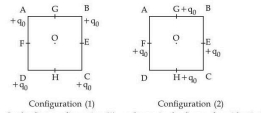
In the first configuration (1) as shown in the figure, four identical charges q0 are kept at the corners A, B, C and D of square of side length a. In the second configuration (2), the same charges are shifted to mid points G, E, H, and F of the square. If K=4πϵ01, the difference between the potential energies of configuration (2) and (1) is given by:
A
aKq02(42−2)
B
aKq02(4−2)
C
aKq02(32−2)
D
aKq02(3−2)
Answer
Correct answer:A
Step-by-step solution
Standard Method
Given: Four identical charges q0 are placed on a square of side a. We need the difference in electrostatic potential energy, ΔU=U2−U1.
Find: The expression for the difference between the potential energies of configuration (2) and configuration (1).
For a system of point charges,
U = \sum_{i
For configuration (1), charges are at the four corners of the square.
There are 4 adjacent pairs, each separated by distance a.
There are 2 diagonal pairs, each separated by distance 2a.
Therefore,
U1=4×aKq02+2×2aKq02
For configuration (2), charges are at the midpoints of the sides.
There are 4 adjacent pairs, each separated by distance 2a.
There are 2 opposite pairs, each separated by distance a.
Therefore, the difference in potential energies is aKq02(42−2), so the correct option is A.
Pair Counting in Both Configurations
Given: The electrostatic potential energy of each pair is rKq02.
Find: Compare all six pairs in the two configurations.
A set of 4 charges gives
(24)=6
pairs in total.
In configuration (1):
4 pairs contribute aKq02 each.
2 pairs contribute 2aKq02 each.
So,
U1=4aKq02+22aKq02
In configuration (2):
4 pairs contribute a/2Kq02 each.
2 pairs contribute aKq02 each.
So,
U2=4a/2Kq02+2aKq02
Since
a/21=a2
we get
U2=a42Kq02+a2Kq02
Now,
ΔU=U2−U1
Therefore,
ΔU=(a42Kq02+a2Kq02)−(a4Kq02+2a2Kq02)
Using
22=2
this becomes
ΔU=aKq02(42−2)
Hence, the correct option is A.
Common mistakes
Counting only the 4 side pairs and forgetting the 2 diagonal pairs is incorrect because a system of four charges has 6 total pairs. Always count all distinct charge pairs before summing potential energy.
Using the midpoint separation as 2a instead of 2a is wrong. Adjacent midpoints form a smaller square, and the side of that square is obtained from geometry.
Taking the difference as U1−U2 instead of U2−U1 changes the sign of the answer. Read carefully which configuration is subtracted from which.
Practice more Electric Potential & Potential Energy questions
Get unlimited AI-adaptive practice, mastery tracking, and an AI tutor that explains every step — free to start.